The vibratory probe we bring to Oakland sites is a heavy, eccentric-mass unit suspended from a crane, typically 30 to 50 tons. It penetrates loose granular soils by vibration and water jetting, then densifies them as we withdraw the probe in lifts. We run depth logs on every lift to confirm the achieved relative density. Before we mobilize, we always review borehole data and run a [MASW survey](/masw-vs30/) to map the low-velocity layers. That survey tells us exactly where the loose pockets are, so we don't waste probe time on already dense ground.
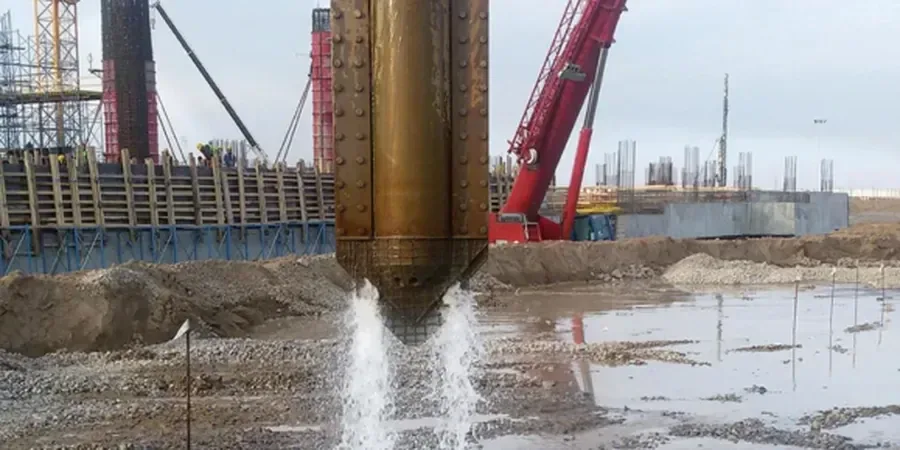
Vibrocompaction in Oakland's fill soils achieves relative densities above 75 percent when probe spacing and energy are calibrated to local grain-size distribution.
Approach and scope
Site-specific factors
What we watch for in Oakland is the variable thickness of the fill layer. Old maps show that the tidal flat edge ran roughly along what is now 7th Street. South of that line, fill can be 12 meters deep; north of it, it might be only 4 meters. If we treat the whole site with the same probe spacing, we over-treat the shallow zones and under-treat the deep ones. The solution is to divide the site into treatment zones based on pre-treatment CPT profiles, then assign different spacing and energy to each zone. We also keep a standby probe because the gravelly pockets in the fill can wear out the tips fast.
Relevant standards
ASCE 7-16 (Minimum Design Loads and Seismic), IBC 2021 (International Building Code, Chapter 18), ASTM D1586-18 (Standard Test for SPT), ASTM D2487-17 (Classification of Soils for Engineering Purposes), FHWA NHI-05-037 (Improvement Methods, Vol. II)
Related technical services
On-site Vibrocompaction Design & Supervision
Full design of probe pattern, energy, and lift sequence based on pre-treatment CPT and SPT data. We supervise the first 20 probes to calibrate the rig settings, then provide daily density verification reports.
Post-Treatment QA Testing
After compaction, we run CPT and SPT at the centroid of each grid cell to confirm relative density. We also perform plate load tests on a 10% sample of the grid. Results are reported within 48 hours.
Typical parameters
FAQ
How much does vibrocompaction design cost in Oakland?
For a typical mid-rise project with 3,000 to 8,000 cubic meters of treatment volume, the design and supervision fee ranges between US$1.290 and US$5.700. This includes pre-treatment data review, probe pattern design, on-site supervision for the first two shifts, and a final compaction report. Larger volumes or multiple treatment zones may increase the cost.
What soil conditions in Oakland require vibrocompaction?
Vibrocompaction works best in loose, clean sands and silty sands with fines below 15%. In Oakland, these soils are common in the former tidal flat areas south of 7th Street and near the Oakland Estuary. If the site has clay layers or organic deposits, we typically recommend deep soil mixing or stone columns instead.
How long does a vibrocompaction program take?
A typical project takes 2 to 4 weeks of on-site probe work, depending on the treatment volume and grid spacing. A 6,000 m³ treatment zone with 3.0 m spacing requires about 150 probe points. At 6 to 8 points per shift, that is roughly 20 shifts. Mobilization and demobilization add 2 days.