In Oakland, we often find ourselves designing retaining walls on hillsides that have already seen some creep over the years. The combination of Franciscan Complex bedrock overlain by colluvium and fill means lateral pressures rarely follow textbook values. Before we size a single reinforcement bar, we run site-specific soil tests and often combine that data with a MASW-Vs30 survey to capture the stiffness profile at depth. That direct measurement of shear-wave velocity is critical when setting the at-rest and active pressure coefficients for the wall design. Ignoring the local geology here just leads to over-designed walls or worse, progressive failure during the next wet winter.
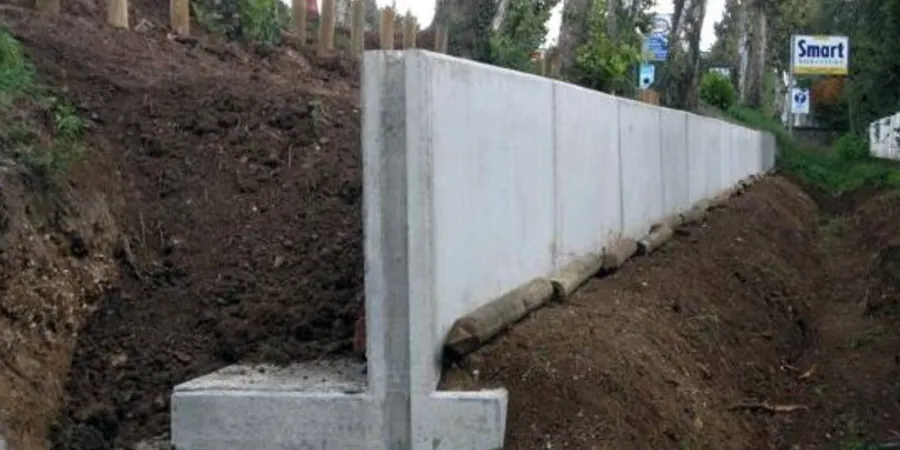
In Oakland, active earth pressures can be 30% higher than textbook values when colluvium is present. We measure, we don't guess.
Approach and scope
Site-specific factors
ASCE 7-22 classifies most of Oakland as Site Class D (stiff soil) or C (very dense soil/soft rock), but the interface between these units is where trouble hides. The primary risk we flag is the presence of a weak layer – often a clayey silt or weathered shale – that can act as a slip surface behind the wall. If that layer is saturated, the shear strength drops dramatically. We always check the global stability of the wall-soil system using a limit-equilibrium method (Bishop simplified or Spencer) and recommend a minimum factor of safety of 1.5 for static and 1.1 for seismic conditions. Retaining wall design in Oakland demands that we treat the soil as a variable, not a constant.
Relevant standards
IBC 2021 – Chapter 18 (Soils and Foundations), ASCE 7-22 – Chapter 11 (Seismic Design Criteria), AASHTO LRFD Bridge Design Specifications – Section 11 (Walls and Abutments), ASTM D1586-18 (SPT), ASTM D2487-17 (Unified Soil Classification)
Related technical services
Site-Specific Retaining Wall Analysis
Includes subsurface exploration (SPT borings, test pits), laboratory testing (triaxial, direct shear), and a full stability analysis. We deliver a signed design report with load calculations, reinforcement schedules, and construction specifications ready for permit submittal.
Seismic Retaining Wall Design
For projects near the Hayward Fault or in high-seismic zones, we perform pseudo-static and displacement-based analyses per ASCE 7. We evaluate liquefaction potential of the retained soil and design for seismic earth pressures using the Mononobe-Okabe method.
Typical parameters
FAQ
What is the typical cost range for a retaining wall design in Oakland?
For a standard residential retaining wall up to 8 ft high, the geotechnical design fee typically ranges from US$1.090 to US$3.950 depending on the number of borings, laboratory tests, and complexity of the slope. Taller walls or sites with poor access may increase the cost.
Do I need a geotechnical report for a retaining wall under 4 ft in Oakland?
Per Oakland Building Code, walls over 4 ft in height that support a surcharge or are located in a seismic zone typically require a soils report. Even for shorter walls, we recommend a site visit and a simple soil classification to avoid surprises with drainage or settlement.
What soil conditions in Oakland cause retaining wall failures?
The most common failure we see is due to undrained clay layers that lose strength when saturated, combined with inadequate drainage. Another frequent issue is the presence of loose fill behind the wall that settles, creating voids and increasing lateral pressure. A proper subsurface investigation prevents both.