We roll into Oakland job sites with a pugmill mixer, a spreader truck, and a pneumatic lime tanker to treat problem soils right where they sit. The typical setup involves spreading Type S hydrated lime or Portland cement at dosages between 3% and 8% by dry weight, then blending to a uniform depth of 12 to 24 inches. For projects along the I-880 corridor, where bay mud can have moisture contents above 60%, we often start with a densidad cono de arena test to establish baseline density before mixing. The process transforms plastic, high-water-content soils into a workable, low-plasticity fill that meets Caltrans specifications.
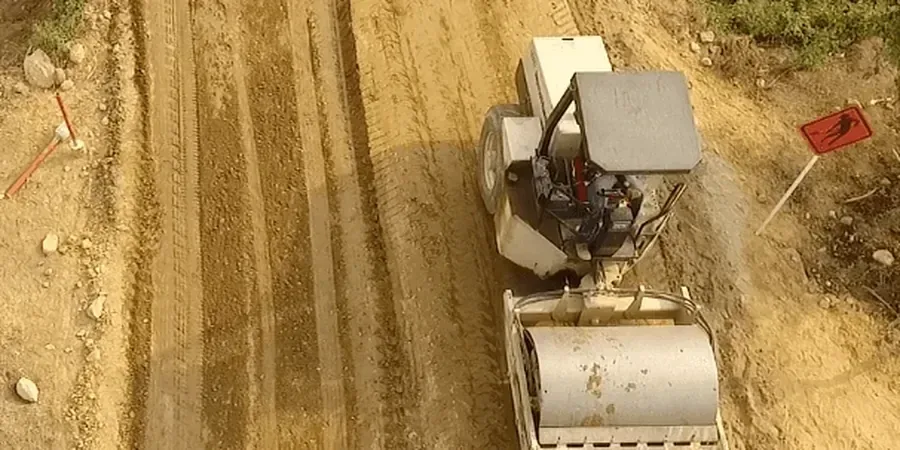
Lime stabilization can cut plasticity index from 40 to under 15 in one pass, turning bay mud into structural fill.
Approach and scope
Site-specific factors
We saw a retaining wall project in the Oakland Hills fail because the contractor skipped lime stabilization for a fat clay backfill. The clay swelled 3 inches after the first wet season, pushing the wall out of alignment and cracking the facing panels. That repair cost more than the original wall. When you have expansive soils—and Oakland has plenty of them near the Hayward Fault zone—untreated clay can generate pressures exceeding 8,000 psf. A proper stabilization program, combined with muros de contención designed for the treated soil parameters, avoids that nightmare entirely.
Relevant standards
ASTM D6276 – Standard Test Method for Determining Lime Content in Treated Soils, ASTM D1633 – Compressive Strength of Soil-Cement, ASTM C977 – Standard Specification for Quicklime and Hydrated Lime for Soil Stabilization, Caltrans Standard Specifications Section 28 – Lime and Cement Treatment
Related technical services
Lime Stabilization for Expansive Clays
Hydrated lime mixed on-site to reduce plasticity, dry high-moisture soils, and create a stable subgrade for roads, slabs, and foundations.
Cement Stabilization for Low-Strength Fill
Portland cement blended into loose fill or sandy soils to achieve UCS between 100 and 200 psi, suitable for structural support.
Deep Soil Mixing with Lime-Cement Columns
For soft bay mud deposits thicker than 10 feet, we install deep mixed columns using a dual-shaft rig to improve bearing capacity and reduce settlement.
Typical parameters
FAQ
How does lime stabilization differ from cement stabilization for Oakland soils?
Lime works best on high-plasticity clays (PI > 30) by modifying the clay mineralogy through cation exchange. Cement is better for sandy or low-plasticity soils where strength gain is the primary goal. In Oakland, we often use lime for the Franciscan Formation clays and cement for alluvial sands along the creeks.
What is the typical cost for lime or cement stabilization in Oakland?
The cost ranges from US$960 to US$2,660 per station (100-foot by 10-foot lane) depending on depth, dosage, and access. Price varies with project volume and testing requirements.
Can stabilization be done during the rainy season in Oakland?
Yes, but we adjust the mix to account for high moisture content. Lime stabilization is actually more effective in wet conditions because the lime absorbs water. We avoid mixing when rainfall exceeds 0.1 inches per hour or when the soil is saturated to the point of rutting under equipment.
What testing is required after stabilization is complete?
We run field density tests (ASTM D6938), unconfined compression tests on 7-day cured samples (ASTM D1633), and Atterberg limits (ASTM D4318) to verify that plasticity has been reduced to the target level. For lime-treated soils, we also check pH to confirm full hydration.
How long does lime or cement stabilization take to cure before construction can proceed?
For lime, a minimum of 24 to 48 hours of mellowing period is required before compaction. Cement sets faster—compaction should occur within 2 hours of mixing. After compaction, a 7-day moist cure is standard before placing pavement or structural fill.