A track-mounted drill rig equipped with continuous flight augers and a hollow-stem setup is typically mobilized for deep excavation design projects across Oakland's varied terrain. The crew first advances a borehole through fill, alluvium, and into the underlying Franciscan Complex bedrock while collecting split-spoon samples at regular intervals. These samples undergo laboratory classification and strength testing to define the soil profile that will guide shoring requirements and excavation sequencing. For deeper cuts approaching 40 feet, the team often installs piezometers during drilling to measure pore pressures that affect temporary support design. The combination of real-time drilling data and lab results forms the basis for a detailed geotechnical design of deep excavations in Oakland.
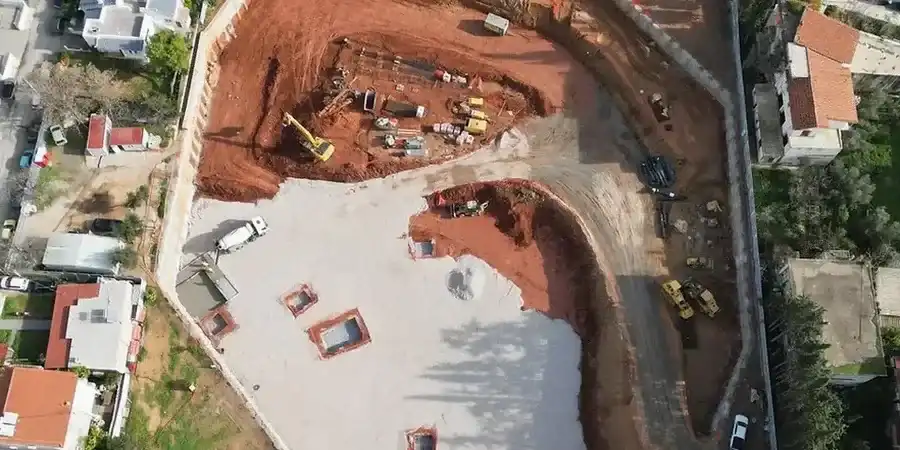
The 30-foot-deep excavation adjacent to a historic brick building required soldier piles every 6 feet with tiebacks grouted into the bedrock to limit lateral movement to under 0.5 inches.
Approach and scope
Site-specific factors
In Oakland, many projects encounter undocumented fill or abandoned utility trenches that were never properly compacted. If the design assumes a uniform soil profile and the excavation face exposes a loose pocket of debris, the unsupported span can collapse within minutes, endangering workers and damaging adjacent streets. The most effective safeguard is a phased exploratory program: after the initial boreholes, the team digs two or three test pits at critical corners to visually confirm the stratigraphy before finalizing the shoring layout. Skipping this verification step is the single most common cause of cost overruns on deep excavation work in the city.
Relevant standards
ASCE 7-22 (Minimum Design Loads and Associated Criteria for Buildings), IBC 2024 (International Building Code, Chapter 18 – Soils and Foundations), ASTM D1586-18 (Standard Test Method for Standard Penetration Test (SPT)), FHWA NHI-09-119 (Earth Retaining Structures and Excavation Support, 2009), Caltrans Trenching and Shoring Manual (2021)
Related technical services
Shoring and Bracing Design
Soldier pile and lagging, sheet pile, or secant pile wall design with internal bracing or tieback anchors, including load take-downs for seismic and surcharge conditions.
Groundwater Control Analysis
Evaluation of dewatering requirements using wellpoints, deep wells, or cutoff walls, supported by pumping tests and groundwater modeling for Oakland's layered aquifers.
Instrumentation and Monitoring Plan
Specification of inclinometers, survey targets, and piezometers to track wall deflection, ground settlement, and pore pressure during excavation, with action thresholds per IBC 2024.
Typical parameters
FAQ
How much does a geotechnical design of deep excavations in Oakland typically cost?
For a typical urban project in Oakland, the geotechnical design of deep excavations ranges from US$1,880 to US$8,390 depending on the number of borings, laboratory testing scope, and complexity of the shoring system. A small residential basement with soldier piles may fall near the lower end, while a multi-level parking structure with tiebacks and dewatering often reaches the upper bound.
What soil conditions most affect deep excavation design in Oakland?
Oakland presents a mix of soft Bay Mud, stiff alluvial clays, and Franciscan Complex bedrock. The Bay Mud layers are highly compressible and can cause long-term settlement behind the wall, while the bedrock offers excellent anchor capacity. A thorough subsurface investigation is essential to identify the depth and extent of each layer.
How long does the design process take for a typical deep excavation?
From initial site visit to final stamped shoring drawings, the process usually takes 3 to 6 weeks. The schedule depends on drilling conditions, laboratory turnaround, and the complexity of the bracing system. Expedited service is available when project timelines are tight.