Oakland's geology presents a tough puzzle for road embankment design. The deep Bay Mud that underlies much of the flatlands compresses significantly under load, while the 1914-era fill along the estuary creates variable conditions. In our experience, the key to a stable embankment here is not just achieving the right compaction — it is understanding how the soft estuarine clays will behave over time under the new load. We always start with a detailed site investigation that includes cone penetration testing and undisturbed sampling. Before finalizing any fill geometry, we run consolidation tests to predict long-term settlement. For fills over 15 feet in height, we often recommend combining staged construction with a drainage layer system to accelerate pore pressure dissipation across these low-permeability soils.
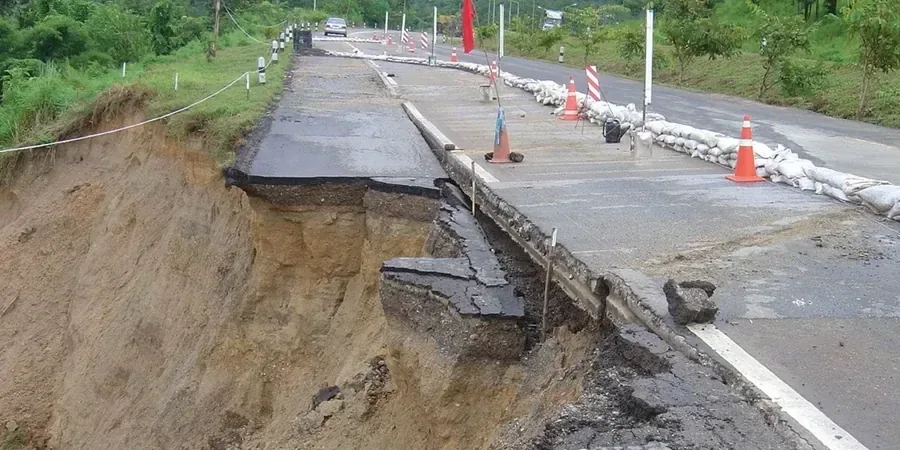
Bay Mud compressibility and 0.6g seismic demand make Oakland embankment design a balance between settlement control and lateral stability.
Approach and scope
- Subsurface profiling with CPTu and SPT to identify weak layers
- Stability analysis using Spencer's method for circular and non-circular slip surfaces
- Settlement prediction with Terzaghi's one-dimensional consolidation theory
Site-specific factors
The wet season in Oakland, from November to March, saturates the near-surface soils and drops the factor of safety on any unfinished embankment. A rain event during construction can trigger a shallow slide along the fill-native soil interface before the shear strength has time to develop. Combine that with the 1906 Hayward Fault scenario — a magnitude 7.4 event from the nearby fault — and the embankment must resist both static and cyclic loading. We design for post-liquefaction stability using the residual strength of the Bay Mud, which can drop to half its static value after strong shaking. Proper drainage, staged loading, and seismic reinforcement are non-negotiable for long-term performance in Oakland.
Relevant standards
ASCE 7-16 (Minimum Design Loads – seismic site class E), IBC 2021 (Chapter 18 – Soils and Foundations), FHWA-NHI-05-037 (Mechanically Stabilized Earth Walls), ASTM D2435 (Consolidation of Soils)
Related technical services
Subsurface Investigation & Soil Characterization
Boring and sampling program using hollow-stem augers and Shelby tubes to retrieve undisturbed samples of Bay Mud. Field vane shear tests measure in-situ undrained strength, while lab consolidation tests determine compressibility parameters for settlement analysis.
Embankment Stability & Settlement Analysis
Limit equilibrium slope stability using Bishop and Spencer methods to evaluate circular and non-circular failure surfaces. We compute primary and secondary consolidation settlements under fill loads, with staged construction schedules to control pore pressure buildup in the soft clay.
Seismic Design & Liquefaction Assessment
Cyclic stress ratio evaluation following the NCEER/Youd-Idriss procedure for liquefaction triggering. We compute post-seismic settlement and lateral spreading potential, then design reinforcement (geotextiles, stone columns, or lightweight fill) to meet IBC seismic drift limits.
Typical parameters
Service video
FAQ
Why is Bay Mud so problematic for road embankments in Oakland?
Bay Mud is a soft, highly compressible estuarine clay with low undrained shear strength (200–800 psf) and a high compression index (Cc up to 0.60). Under the weight of a fill, it consolidates slowly over years, causing large differential settlements. Its low permeability means pore pressures dissipate slowly, prolonging instability during construction.
What does a road embankment design study typically cost in Oakland?
The cost ranges from US$1.310 to US$4.440 depending on the embankment height, access conditions, and the number of borings required. A small fill under 10 feet with one boring and settlement analysis falls at the lower end, while a tall embankment with seismic evaluation and staged construction design reaches the upper end.
How do you account for the Hayward Fault in embankment design?
We use the USGS 2014 hazard model to determine the design ground motion (PGA ≈ 0.6g for site class E). The embankment must resist both the static load and the cyclic loading from a magnitude 7.4 earthquake on the Hayward Fault. We check for liquefaction of sandy lenses, compute post-seismic settlement, and design the fill geometry to maintain a factor of safety above 1.1 under seismic conditions.
Can I build a road embankment directly on Bay Mud without Improvement?
It is possible for very low fills (under 5 feet) on thick Bay Mud, but even then you risk long-term differential settlements of several inches. For fills over 10 feet, Improvement is almost always necessary. Options include staged construction with wick drains, stone columns, or lightweight fill (expanded polystyrene or cellular concrete) to reduce the load on the soft clay.