Oakland sits atop a complex mix of alluvial deposits, Bay Mud, and bedrock from the Franciscan Complex. This varied geology means seismic site response can shift dramatically within a few blocks. The HVSR microtremor survey (Nakamura method) captures ambient vibrations to identify the fundamental resonance frequency of the ground. It is a non-invasive, cost-effective way to understand how the soil column might amplify earthquake shaking. Before designing foundations or planning structural retrofits, this survey provides a clear baseline of site behavior. Integrating the results with a tomografía sísmica can further refine the velocity model for deeper layers.
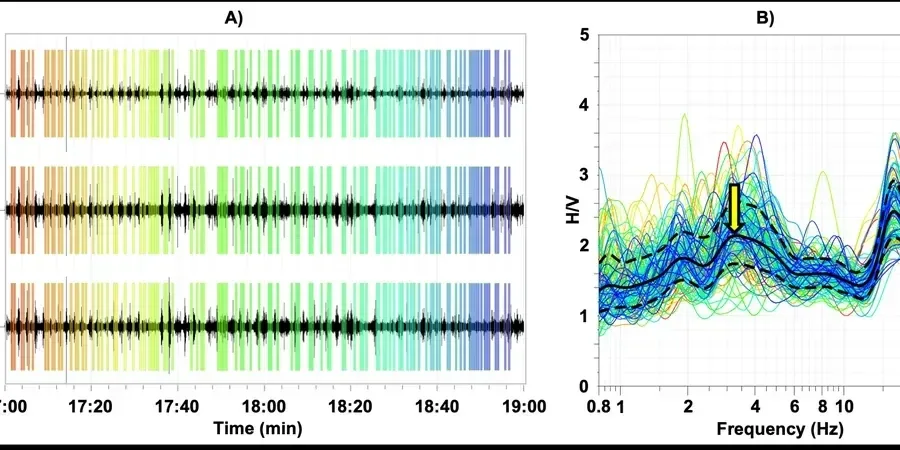
A single HVSR reading can reveal whether your site will amplify shaking by a factor of two or more at its resonant frequency.
Approach and scope
Site-specific factors
The San Francisco Bay Area experiences frequent small earthquakes and occasional large events like the 1989 Loma Prieta quake. Oakland's soft soils in the flatlands are prone to amplification and liquefaction. Skipping a site-specific HVSR microtremor survey (Nakamura method) means designing blindly for seismic loads. A building may resonate with the ground motion at its natural period, doubling or tripling the forces on the structure. This risk is especially high for mid-rise buildings (5–15 stories) whose fundamental periods often match the 0.5–2 Hz range common in deep basin areas. The survey costs a fraction of the potential retrofit or repair bill.
Relevant standards
SESAME (Site Effects Assessment Using Ambient Excitations) Guidelines (2004), ASCE 7-22 — Minimum Design Loads and Associated Criteria for Buildings (Seismic Site Class), IBC 2021 — International Building Code, Chapter 16 (Site Response), ASTM D7400-19 — Standard Test Methods for Downhole Seismic Testing
Related technical services
Single-Station Survey
A rapid assessment using one seismometer at the project location. Ideal for small lots, single-family homes, or preliminary screening. Delivers the fundamental frequency and amplification factor within 24 hours of field completion.
Multi-Station Array
Deploy four to ten stations across the site to map lateral variations in resonance frequency. This service is recommended for larger parcels, multi-building developments, or sites straddling geologic contacts like the Hayward Fault zone.
Typical parameters
FAQ
How long does an HVSR microtremor survey (Nakamura method) take in Oakland?
A single-station measurement takes about 1.5 hours including setup, recording, and retrieval. Multi-station arrays require 4 to 6 hours of field time plus post-processing. Full results are typically delivered within 2 business days.
What is the difference between HVSR and MASW?
HVSR measures the H/V spectral ratio of ambient noise to find the resonance frequency and amplification. MASW uses active or passive surface waves to derive a vs30/" data-interlink="1">shear wave velocity (Vs) profile with depth. HVSR is faster and cheaper; MASW provides velocity data needed for IBC site class determination.
How much does an HVSR microtremor survey (Nakamura method) cost in Oakland?
Pricing depends on the number of stations, site accessibility, and urgency. A typical single-station survey for a residential lot ranges between US$1,430 and US$2,300. Multi-station projects are quoted per station after a quick site review.
Can HVSR data be used for retrofitting an existing building in Oakland?
Yes. The resonance frequency helps engineers check if the building's natural period aligns with the site frequency. If they match, the retrofit can target that specific period to reduce amplification. It is a low-cost diagnostic step before committing to structural upgrades.