When we review geogrid specification documents for Oakland projects, the first thing we check is the site's native soil stiffness. Oakland sits on a mix of alluvial fan deposits, Franciscan complex bedrock, and former marshland near the estuary — each demands a different geogrid class. A standard biaxial geogrid for a retaining wall in the Oakland Hills might be overkill on Bay Farm Island, where soft bay mud requires higher junction efficiency and lower aperture stability. We always pair the geogrid specification with the ensayo de compresión simple to correlate unconfined compressive strength with confinement requirements, and we cross-check the ensayo Proctor results to verify compaction curves meet the 95% minimum before geogrid placement. This layered approach avoids both under-design and unnecessary material cost.
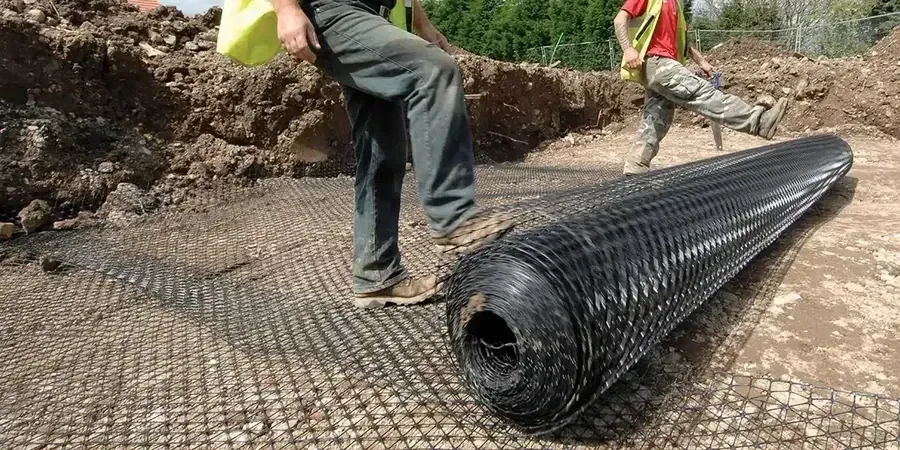
A geogrid specification that ignores Oakland's wet-dry cycles and bay mud compressibility will fail at the junction under sustained load.
Approach and scope
Site-specific factors
Oakland's urban development accelerated after the 1906 earthquake, with much of the flatland built on uncompacted fill over marsh. That legacy means many older retaining walls and slopes were constructed without any geogrid reinforcement at all. When we see a retaining wall that has bulged or tilted after heavy rain in the lower Oakland neighborhoods, it is almost always because the original design lacked a proper geogrid specification — or worse, the geogrid installed did not meet the required tensile strength for the actual soil conditions. For new projects near Lake Merritt or along the estuary, a documented geogrid specification tied to site-specific soil testing is the only way to guarantee long-term stability.
Relevant standards
ASTM D6637-18 (Tensile Properties of Geogrids), AASHTO M288-21 (Geotextile Specification – applicable to geogrids in pavement), ASTM D5262-21 (Creep of Geogrids under Sustained Load), FHWA NHI-09-087 (Design of Mechanically Stabilized Earth Walls)
Related technical services
Site-Specific Geogrid Selection
We review the soil classification (ASTM D2487), compaction test results, and groundwater data from your Oakland site, then select the geogrid type — biaxial, uniaxial, or triaxial — and define the required tensile strength, junction efficiency, and creep limits.
Specification Documentation & Review
Our team prepares a complete geogrid specification section for your project plans, including manufacturer prequalification criteria, installation quality control (IQC) testing frequency, and field verification methods such as roll sampling and tensile testing.
Typical parameters
FAQ
What is the difference between biaxial and uniaxial geogrids in an Oakland context?
Biaxial geogrids distribute load in both machine and cross-machine directions, making them suitable for paved roads and working platforms over Oakland's soft bay mud. Uniaxial geogrids have high strength in one direction only and are used for MSE walls and steep slopes in the Oakland Hills, where the primary load is horizontal due to retained earth.
How does the Oakland seismic zone affect geogrid specification?
Oakland is in Seismic Design Category D per ASCE 7. That requires geogrids with higher creep resistance and junction strength to withstand cyclic loading during an earthquake. We typically specify a creep reduction factor of 1.5–2.0 and require dynamic triaxial testing on the soil-geogrid composite to verify performance under simulated seismic shaking.
What is the typical cost range for a geogrid specification study in Oakland?
A full geogrid specification study — including soil testing, tensile verification, and a written specification report — typically ranges between US$420 and US$1,450. The final cost depends on the number of soil layers, the complexity of the reinforcement design, and whether field validation testing is included.
Can I use a standard geogrid specification from another city for my Oakland project?
We strongly advise against it. Oakland's soil profiles vary dramatically within a few blocks — from stiff claystone in the hills to soft compressible clay in the flatlands. A specification designed for Sacramento's sandy soils or Los Angeles' alluvial fans will not capture Oakland's specific creep demands, wet-dry cycles, or seismic requirements. A site-specific specification is the only way to ensure long-term performance.