A common mistake we see among contractors in Oakland is assuming that a deep foundation is always needed for soft ground. That assumption drives up cost and delays schedules unnecessarily. For many sites along the estuary or near Lake Merritt, preloading design without surcharge is a smarter first step. It consolidates the compressible layers before you pour a single slab. We apply staged fills and monitor pore pressure dissipation using piezometers. Combining this with an ensayo CPT gives us continuous stratigraphy profiles, which is critical for predicting how the fill will perform. The result is a buildable platform with controlled post-construction settlement.
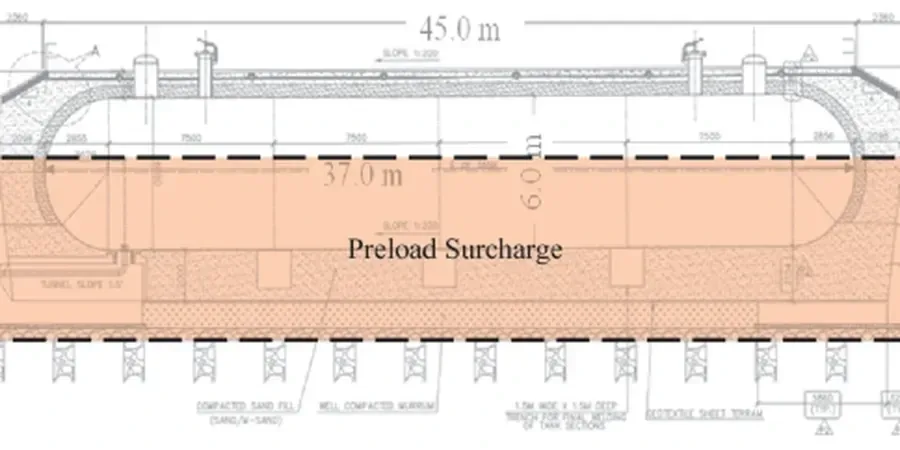
Preloading without surcharge can reduce post-construction settlement by up to 80% on Oakland's soft estuarine clays, saving weeks of schedule delay.
Approach and scope
Site-specific factors
Oakland sits on a mix of Holocene alluvium and bay mud. The 1989 Loma Prieta earthquake (M6.9) triggered widespread liquefaction and settlement in the Marina District and along the estuary. If you skip preloading design without surcharge on a soft site, differential settlement can crack slabs, misalign utilities, and compromise tilt-up panels. We've seen projects where 4 inches of differential settlement occurred within two years of occupancy. That's why we model consolidation using site-specific parameters from undisturbed samples. You get a preload plan that fits the actual soil behavior, not a generic table.
Relevant standards
ASCE 7-22 (Minimum Design Loads and Criteria), IBC 2021 (Chapter 18 – Soils and Foundations), ASTM D2435 (One-Dimensional Consolidation), ASTM D1586-18 (Standard Penetration Test)
Related technical services
Preload Design with Settlement Analysis
Full consolidation analysis using site-specific oedometer data, staged fill schedule, settlement monitoring plan, and post-construction settlement verification. Includes pore pressure dissipation modeling.
Preload Monitoring & Verification
Field installation of settlement plates, piezometers, and survey benchmarks. Weekly reporting with settlement curves and pore pressure trends. Final verification report for foundation approval.
Typical parameters
FAQ
How is preloading without surcharge different from surcharging?
Preloading without surcharge uses fill height equal to or slightly above the final grade, without extra weight. Surcharging uses additional fill to accelerate consolidation. Without surcharge, the process takes longer but avoids the cost of removing excess fill. It works well for Oakland sites where schedule allows 6-12 months of preload.
What is the typical cost range for a preloading design in Oakland?
For a standard commercial lot in Oakland, preloading design without surcharge typically ranges between US$740 and US$2,280. The final cost depends on site area, number of monitoring points, and testing scope. We provide a detailed quote after reviewing the geotechnical report.
How long does preloading take on Oakland's bay mud?
For soft estuarine clay with moderate thickness (10-20 ft), preloading without surcharge generally takes 6 to 12 months. Thicker layers may require up to 18 months. We monitor pore pressure dissipation to determine when the soil reaches 90% consolidation. The schedule is confirmed with site-specific lab data.
Can preloading be combined with other Improvement methods?
Yes. Preloading works well with vertical drains (wick drains) to accelerate consolidation, or with light-weight fill to reduce net load. For Oakland sites with high groundwater, we also recommend combining preload with a drainage blanket. Each combination is designed case by case based on the soil profile.