Oakland grew rapidly in the late 19th century, expanding over marshlands and alluvial plains along the eastern shore of San Francisco Bay. Much of the city sits on soft estuarine deposits, loose sands, and former tidal flats. These soils lack the bearing capacity needed for medium to high-rise structures. Stone column design emerged as a practical solution for this setting. The method densifies loose granular layers and reinforces cohesive strata using compacted gravel columns. Before specifying stone columns, engineers often run a georadar GPR survey to map buried utilities and shallow anomalies. They also perform MASW Vs30 profiling to characterize shear-wave velocity profiles across the site.
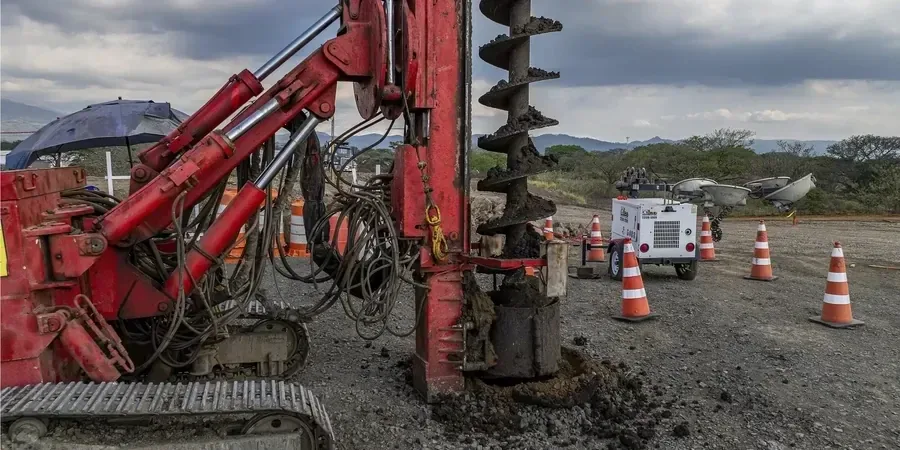
Stone columns reduce settlement and mitigate liquefaction risk in Oakland's soft alluvial soils by densifying loose granular layers.
Approach and scope
Site-specific factors
Oakland sits in a seismically active region near the Hayward and San Andreas faults. Loose saturated sands and silts are prone to liquefaction during strong shaking. Stone column design directly addresses this risk. The columns provide drainage paths that relieve excess pore pressure. They also densify the surrounding soil through vibration and displacement. However, variable groundwater levels and undocumented fill from past industrial use demand careful site investigation. In some areas, buried organic layers can degrade column performance if not fully penetrated. A thorough characterization of soil stratigraphy is essential before committing to a stone column layout.
Relevant standards
ASTM D1586-18, ASTM D2487-17, ASCE 7-22, FHWA NHI-05-037, IBC 2021 Chapter 18
Related technical services
Vibro-replacement stone columns
Installation of dense gravel columns using a vibratory probe. Suitable for soft clays, silts, and loose sands. The probe penetrates under its own weight, and gravel is fed through the side or top. Each lift is compacted by repeated probe insertion. This method achieves area replacement ratios between 15 and 30 percent.
Vibro-displacement stone columns
For cleaner granular soils where densification is the primary goal. The vibratory probe displaces soil laterally without removing material. Gravel is added in stages as the probe is withdrawn. This technique works well in Oakland's loose hydraulic fills and alluvial sands. It can reach depths of 15 meters or more.
This service complements our laboratory testing work for a complete project analysis.
Typical parameters
FAQ
How does stone column design reduce liquefaction risk in Oakland?
Stone columns act as vertical drains and densification elements. During an earthquake, excess pore pressure builds up in loose saturated sands. The gravel columns provide high-permeability drainage paths that allow pore water to dissipate rapidly. Additionally, the vibro-installation process densifies the surrounding soil, increasing its relative density and resistance to cyclic shear. In Oakland, this approach is particularly effective in the alluvial deposits beneath downtown and the estuary shoreline.
What is the typical cost range for stone column design and installation in Oakland?
The cost typically falls between US$1,530 and US$5,930 per column, depending on column diameter, depth, and site access conditions. Volume discounts apply for large grids with many columns. A detailed geotechnical investigation is needed to finalize the design and provide an accurate quote.
How deep can stone columns be installed in Oakland's variable soil profile?
Installation depths of 10 to 18 meters are common in Oakland. The limiting factor is often the presence of dense older alluvium or bedrock below the soft layers. Vibro-replacement equipment can typically penetrate through soft clays and loose sands to these depths. A pre-design borehole program is recommended to confirm the thickness of the treatable stratum.