Soils in the Oakland flatlands near Lake Merritt contrast sharply with those in the Oakland Hills. The former consist of soft bay mud and fill over dense alluvium, while the hillside slopes expose Franciscan Complex bedrock and colluvium. Electrical resistivity surveys help us map these transitions without a single drill hole. On a recent project along Grand Avenue, we used Vertical Electrical Sounding (VES) to locate the bedrock interface beneath 40 feet of soft clay, saving the client from unnecessary deep borings. The same method works well for detecting groundwater tables in the alluvial fans of Dimond Canyon. Complementing resistivity with a georradar GPR survey gives us a sharper picture of shallow utilities and buried structures before we mobilize larger equipment.
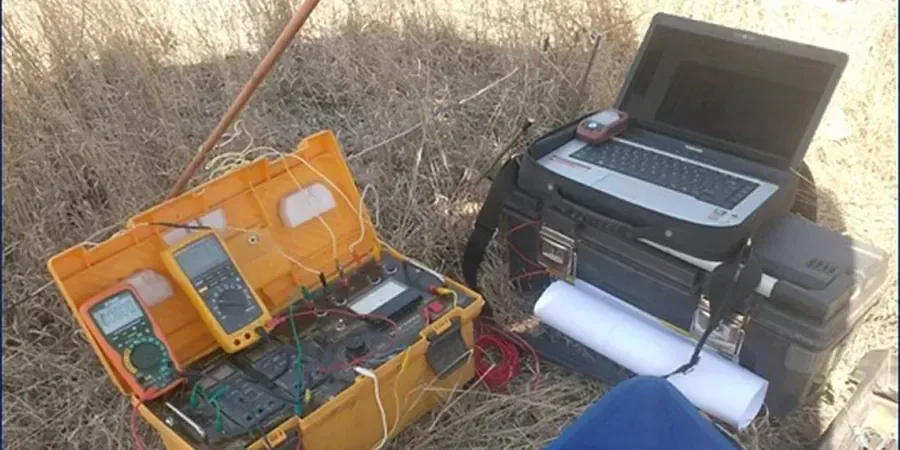
Resistivity profiles from 0.5 to 2000 ohm-m resolve clay, sand, bedrock and groundwater in Oakland's complex geology.
Approach and scope
Site-specific factors
We saw a retaining wall failure on a 14-unit condo project near Piedmont Avenue back in 2019. The geotechnical report relied solely on three SPT borings and missed a steeply dipping clay seam that acted as a slip plane after heavy rain. An electrical resistivity survey would have detected that low-resistivity clay layer before construction. Without it, the wall moved 4 inches and cost the developer over $80,000 in emergency shoring. In Oakland's hilly terrain, resistivity is not a luxury — it is a risk management tool. We also combine it with estabilidad de taludes analysis for slopes adjacent to existing homes. The cost of a resistivity survey is small compared to a single day of claims litigation.
Relevant standards
ASTM D6431-18, ASTM D6429-20, ASTM D5088-20
Related technical services
Vertical Electrical Sounding (VES)
1D soundings with expanding electrode spacing to map vertical resistivity changes. Ideal for groundwater table depth, bedrock depth, and layer thickness in alluvial basins. Common in Oakland flatlands for shallow foundation studies. Each VES point takes 1–2 hours in the field with real-time data QC.
2D Electrical Resistivity Imaging (ERI)
Multi-electrode arrays producing continuous 2D cross-sections. Used for fault zone mapping, landslide investigation, and cavity detection. In Oakland Hills we deploy 48-electrode lines along slope contours to identify weak zones before road or building construction. Inversion models resolve features down to 1 meter resolution.
Typical parameters
FAQ
How deep can electrical resistivity survey reach in Oakland soils?
With a 200-meter cable spread and 48 electrodes, we typically reach 50 to 60 meters depth in Oakland's alluvial and bay mud deposits. In the hills where bedrock is shallow (10–30 m), the same array resolves the bedrock interface clearly. Deeper targets require longer spreads or dipole-dipole arrays.
What is the cost of an electrical resistivity / VES survey in Oakland?
A typical VES survey with 5 soundings and interpretation runs between US$560 and US$1,060 depending on site access, number of soundings, and reporting level. For a full 2D line with 48 electrodes and inversion modeling, expect US$1,200 to US$2,500. Volume discounts apply for multiple lines.
Can resistivity distinguish between clay and sand in Oakland?
Yes, generally. Saturated clay in Oakland's bay deposits shows resistivity below 10 ohm-m, while clean sand and gravel range from 50 to 500 ohm-m. Dry sand or fill can exceed 500 ohm-m. We always calibrate resistivity with at least one SPT boring or test pit to confirm lithology, because local fill materials can produce ambiguous readings.