A common mistake we see among construction teams in Oakland is relying solely on visual-manual soil classification or outdated borings when designing shallow foundations. Without direct measurement of undrained shear strength, a clay layer that looks competent can actually have low load-bearing capacity. That is exactly where the unconfined compression test (UCS) fills a critical gap. This simple yet powerful laboratory test measures the unconfined compressive strength of a cohesive soil specimen, giving engineers a quick, reliable value for short-term stability analysis. In Oakland’s varied geology—from the alluvial fans near Lake Merritt to the stiffer clays of the Oakland Hills—skipping this test often leads to overconservative or unsafe foundation designs. The unconfined compression test (UCS) is particularly valuable for verifying that the soil beneath a footing or slab can support design loads without excessive settlement. For projects where consolidation is a concern, combining UCS data with a consolidation test provides a complete picture of both strength and settlement behavior.
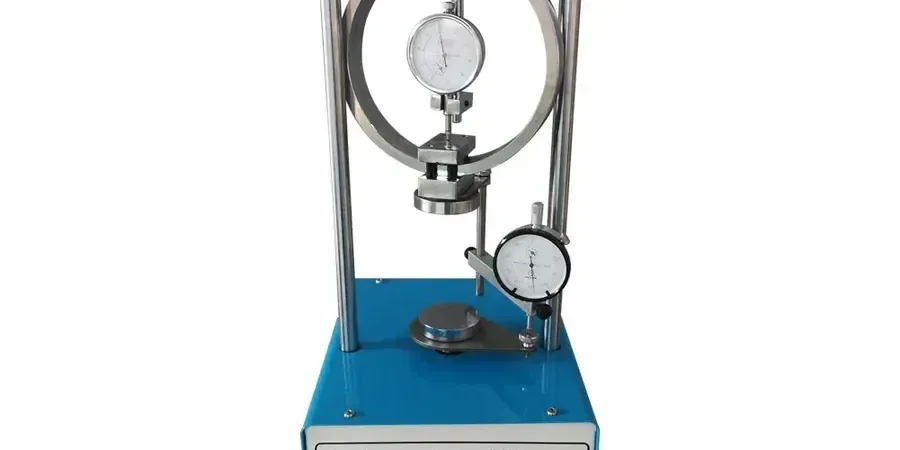
For Oakland’s soft Bay Mud clays, the unconfined compression test (UCS) reveals undrained strengths as low as 0.2 kg/cm², which directly governs shallow foundation sizing.
Approach and scope
- Unconfined compressive strength (qu)
- Undrained shear strength (su = qu/2)
- Strain at failure (%)
- Stress-strain curve
- Moisture content at time of test
Site-specific factors
Picture a 10-story residential tower planned for a site along San Pablo Avenue, where the upper 6 meters consist of soft to medium stiff clay. Without an unconfined compression test (UCS), the design team assumed an undrained shear strength of 0.5 kg/cm² based on nearby borings. The actual UCS results showed only 0.25 kg/cm² in several layers, meaning the spread footings would have settled 40% more than allowed under the code. That discovery forced a redesign to deep piles, adding months and over $300,000 to the budget. In Oakland, where the 1989 Loma Prieta earthquake showed how soft soils amplify seismic motion, ignoring the UCS test can also lead to underestimating liquefaction-induced bearing loss. The unconfined compression test (UCS) remains the most direct, affordable way to confirm that your clay’s real strength matches the assumptions in your structural model.
Relevant standards
ASTM D2166-16 Standard Test Method for Unconfined Compressive Strength of Cohesive Soil, ASTM D1587-15 Standard Practice for Thin-Walled Tube Sampling of Fine-Grained Soils, ASTM D2488-17 Standard Practice for Description and Identification of Soils (Visual-Manual Procedures)
Related technical services
Triaxial Compression Tests (UU, CU, CD)
For projects requiring a more complete stress path or drained strength parameters, we perform unconsolidated-undrained (UU), consolidated-undrained (CU), and consolidated-drained (CD) triaxial tests on clay and sand samples. These are essential for deep foundations and slope stability analysis in Oakland’s variable soils.
Unconfined Compression Test (UCS) on Intact Samples
We run the UCS test according to ASTM D2166 on 71 mm or 35 mm diameter specimens trimmed from Shelby tubes or block samples. Results include the full stress-strain curve, failure mode, and corrected strength for moisture content. Typical turnaround is 3–5 business days for a batch of 3 to 6 specimens.
Moisture Content & Unit Weight Determination
Accurate strength interpretation depends on knowing the specimen’s in-situ density and water content. We measure both immediately before each UCS test, providing the data needed to correlate strength with consistency limits and evaluate sensitivity in Oakland’s quick clays.
Typical parameters
FAQ
What is the difference between an unconfined compression test (UCS) and a triaxial test?
The UCS test applies axial load to a clay specimen with no confining pressure, measuring the undrained shear strength directly. A triaxial test applies a confining pressure (cell pressure) around the sample, allowing simulation of in-situ stress conditions and measurement of both drained and undrained strength parameters. UCS is faster and cheaper, but triaxial is required when you need the effective stress friction angle or cohesion for deep foundation or slope stability analysis. For Oakland’s soft Bay Mud, the UCS test is often sufficient for shallow foundation design, while triaxial is recommended for embankments or deep excavations.
How many UCS tests do I need for a typical Oakland residential or commercial project?
For a single-family home on a lot with uniform clay, 2 to 3 UCS tests on representative samples from the upper 3 meters are usually adequate. For a commercial building or multi-story structure with variable soil conditions, we recommend 1 UCS test per distinct clay layer encountered in each boring, typically 4 to 8 tests total. The geotechnical engineer will specify the exact number based on the project’s risk profile and the variability observed during drilling. In Oakland’s alluvial deposits, where clay lenses alternate with sand, more tests may be needed to capture the full range of strengths.
What is the typical cost range for an unconfined compression test (UCS) in Oakland?
The typical cost for a single UCS test in the Oakland area is between US$300 and US$470 per specimen, including sample preparation, testing, and a report with the stress-strain curve. Volume discounts apply when testing 6 or more specimens from the same project. Additional charges may apply for special handling of very soft or sensitive samples, or for expedited turnaround (24 hours). The total cost for a small residential project (3 tests) usually falls between US$900 and US$1,400.