A six-story residential project near Lake Merritt needed foundation design data. The geotechnical report from a nearby site was too optimistic. We ran a Flat Dilatometer Test (DMT) to measure lateral stress and modulus directly. The DMT revealed a softer zone at 8 meters that SPT logs had missed. That changed the pile length recommendations and saved the client from differential settlement. For Oakland's mix of young bay mud and colluvial terrace deposits, the DMT gives us parameters that lab tests on disturbed samples cannot replicate. We routinely pair it with a MASW-Vs30 survey to cross-check stiffness profiles and with cone penetration testing for continuous stratigraphy.
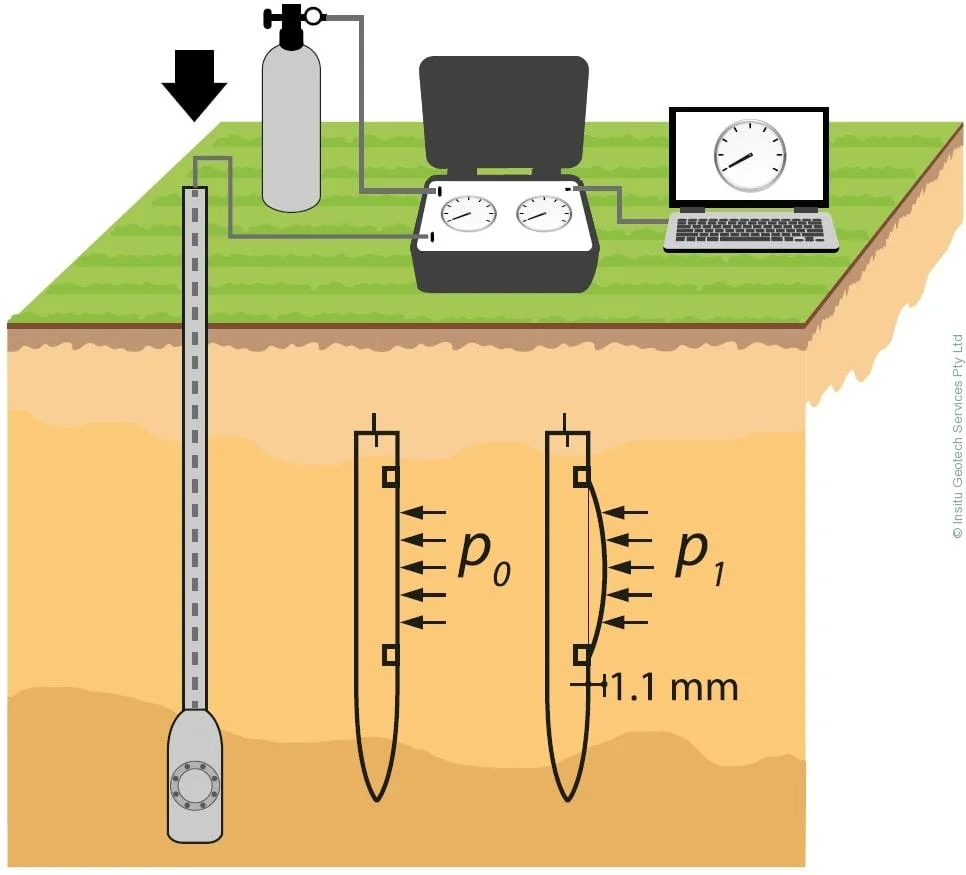
The DMT gave us a constrained modulus profile that matched observed settlements within 12% — far better than correlations from SPT alone.
Approach and scope
Site-specific factors
A common mistake we see in Oakland: contractors rely on SPT N-values alone to estimate settlement in soft clays. The SPT disturbs the soil and gives unreliable modulus for fine-grained materials. Without DMT, designers often underestimate settlement by 30–50% in bay mud. That leads to cracked slabs, tilted structures, and costly underpinning. The DMT measures in-situ stiffness at low strain, exactly what you need for serviceability calculations. We flag this risk early in the design phase so the foundation can be optimized before concrete is poured.
Relevant standards
ASTM D6635-15 (Standard Test Method for Performing the Flat Plate Dilatometer), ASCE 7-22 (Minimum Design Loads for Buildings – Seismic Site Class), FHWA NHI-16-072 Geotechnical Site Characterization (DMT chapter)
Related technical services
Standard DMT Sounding
Full profile with readings every 20 cm. Deliverable includes raw data, corrected parameters, and interpreted profiles of Ed, Kd, Id, M, and OCR. Suitable for settlement analysis and foundation design.
Seismic Dilatometer (SDMT)
Adds vs30/" data-interlink="1">shear wave velocity measurement at 1 m intervals. Used for seismic site classification (ASCE 7 site class), liquefaction triggering analysis, and dynamic soil-structure interaction.
DMT for Embankment Control
Pre- and post-construction DMT to verify improvement in soft ground. Measures modulus increase, OCR change, and stress redistribution after surcharge or wick drain installation.
DMT in Stiff / Overconsolidated Soils
Optimized blade and push system for dense sands and stiff clays common in Oakland's piedmont zone. Provides reliable K0 and lateral stress data for retaining wall and excavation design.
Typical parameters
FAQ
What is the Flat Dilatometer Test (DMT) and how does it work?
The DMT is an in-situ test that pushes a stainless steel blade with a flexible membrane into the soil. At each depth we stop, inflate the membrane, and record two pressures: the lift-off pressure (A) and the 1.1 mm expansion pressure (B). From these we compute the material index, horizontal stress index, and dilatometer modulus. The test is fast, repeatable, and provides low-strain stiffness parameters that laboratory tests cannot match.
How does the DMT compare with SPT or CPT for Oakland soils?
The SPT gives a disturbed sample and a crude blow count; it works for granular soils but underestimates stiffness in clays. The CPT provides continuous tip resistance and pore pressure, which is excellent for stratigraphy. The DMT excels at measuring lateral stress and modulus in fine-grained soils, especially overconsolidated clays and silts. In Oakland's bay mud, the DMT-derived constrained modulus is typically 2–3 times more reliable for settlement predictions than SPT-based correlations.
What is the typical cost range for a DMT sounding in Oakland?
For a standard DMT sounding to 30 meters depth, including mobilization within Oakland and a full interpreted report, the cost typically falls between US$750 and US$1,120 per sounding. The final price depends on the number of soundings, depth, and whether seismic (SDMT) measurements are added. We provide a firm quote after reviewing the site conditions and access.
How deep can the DMT reach in Oakland soils?
We routinely push to 40 meters in soft to medium clays and silts. In dense sands or stiff clays with N-values above 30, we usually stop at 20–25 meters. The limiting factor is the thrust capacity of our rig (usually 20–25 tons). In Oakland's deepest bay mud deposits near the estuary, we have completed soundings to 50 meters using a high-capacity CPT truck.
What parameters can I get from a DMT that I cannot get from SPT or lab tests?
The DMT provides the horizontal stress index (Kd), which is directly related to the coefficient of lateral earth pressure at rest (K0). It also gives the dilatometer modulus (Ed), a low-strain stiffness parameter that correlates well with settlement behavior. Additionally, we derive the overconsolidation ratio (OCR) more reliably than from oedometer tests on disturbed samples. These parameters are critical for retaining wall design, excavation support, and settlement analysis in Oakland's variable soils.