A mid-rise development on Oakland's waterfront faced 40 feet of soft bay mud. The geotechnical challenge was clear: decades of settlement unless we accelerated consolidation. We designed a PVD grid combined with surcharge to cut that timeline to months. Before specifying the drain pattern, we ran a permeability test in the field to confirm horizontal flow rates. That data drove the spacing calculation. The project stayed on schedule and the owner avoided costly post-construction underpinning.
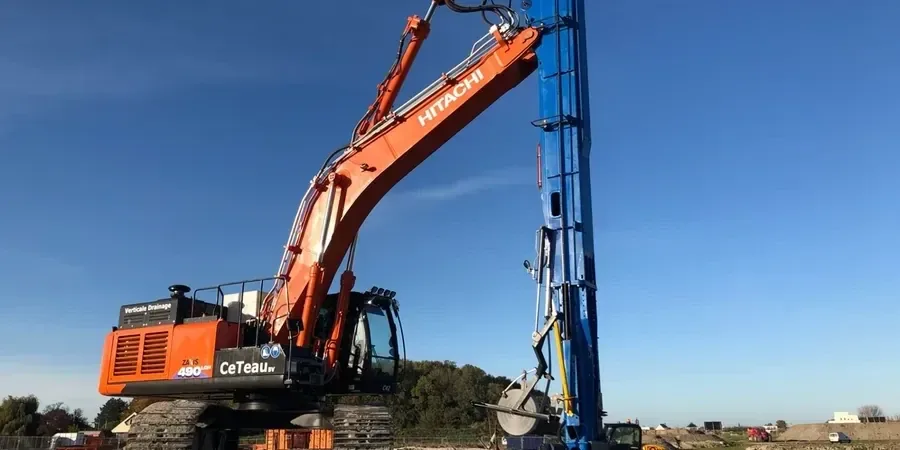
One transit yard in West Oakland hit 90% consolidation in 6 months using a 1.5-meter triangular PVD pattern — a year faster than surcharge alone.
Approach and scope
Site-specific factors
Oakland's flatlands were built on hydraulically placed fill and natural marsh deposits. The 1906 earthquake liquefied those same soils, and the 1989 Loma Prieta event caused widespread lateral spreading. For any PVD design here, we must account for seismic-induced pore pressure. If drains are spaced too wide, excess pore pressure can build up faster than dissipation, leading to strength loss during shaking. We run cyclic triaxial tests on undisturbed samples to set the drain layout that keeps pore pressure ratios below 0.6 during the design event.
Relevant standards
ASTM D1586 (SPT), ASTM D2435 (consolidation test), FHWA NHI-06-088 (PVD design manual), ASCE 7-22 (seismic loading)
Related technical services
PVD Layout & Spacing Design
We use consolidation test data and site stratigraphy to compute drain spacing, depth, and pattern. Deliverables include a plan view with coordinates, a time-settlement curve, and a construction sequence for staged surcharge.
Performance Verification Testing
After drain installation, we monitor pore pressure dissipation with vibrating-wire piezometers and compare actual settlement against the predicted curve. If the rate lags, we adjust the surcharge schedule or add intermediate drains.
Typical parameters
Service video
FAQ
How long does PVD installation take for a typical Oakland infill site?
For a 1-acre lot with 30-foot soft clay, installation of a triangular grid at 1.5-m spacing takes 5 to 8 working days with a track-mounted rig. The consolidation period then runs 3 to 8 months, depending on drain spacing and surcharge height.
What is the typical cost range for PVD design and installation in Oakland?
Design and field testing ranges from US$960 to US$2,250 for a single building pad. Full installation (mobilization, drains, surcharge material, monitoring) typically runs US$8,000 to US$15,000 per acre, but varies with drain depth and site access.
Do PVDs work in Oakland's bay mud with high organic content?
Yes, but the organic layers require wider drain spacing because they have lower horizontal permeability. We run CRS consolidation tests on samples from each organic horizon and model the combined system. In practice, we often use a wider spacing in peat (2.0 m) and tighter spacing in clay (1.2 m) within the same grid.