We recently reviewed a lot on Grizzly Peak Boulevard where the owner wanted to build a retaining structure at the base of a 40-degree slope. The soil profile showed 2.5 meters of colluvium over weathered Franciscan Complex bedrock, a typical setup in the Oakland hills. Before any foundation work, we performed a detailed landslide assessment to map potential slip surfaces and estimate residual shear strength. That data directly informed the design of a tieback anchor system. For slopes with similar geology we often pair the analysis with a MASW survey to profile Vs30 values, and verify soil consistency through standard penetration testing at critical depths. The goal is to reduce uncertainty in the factor of safety calculation before excavation begins.
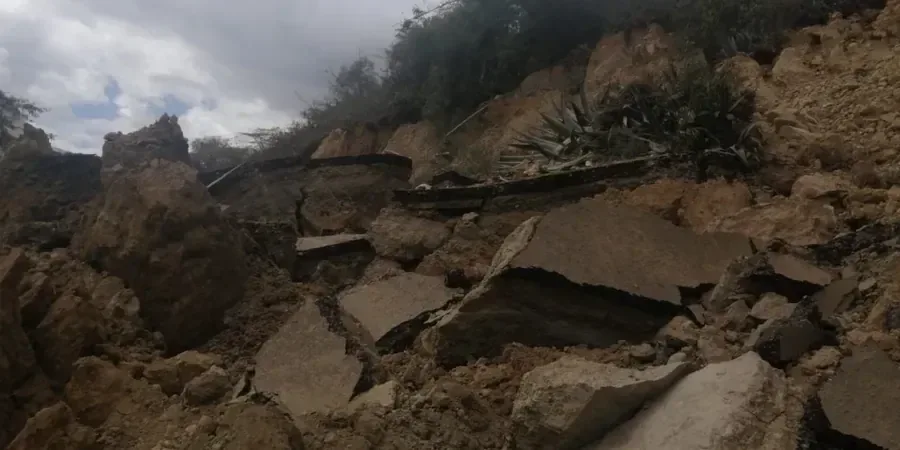
Residual friction angles in Oakland colluvium can drop below 12 degrees under saturated conditions, making slip surface identification critical for safe foundation design.
Approach and scope
Site-specific factors
The 1989 Loma Prieta earthquake triggered hundreds of landslides in the Oakland hills, and the Hayward Fault runs directly east of the city. A magnitude 6.8 event on that fault would produce peak ground accelerations exceeding 0.6 g in the hill areas, enough to mobilize deep-seated slides in the Franciscan mélange. A proper landslide assessment must incorporate pseudostatic seismic coefficients per ASCE 7-22 and evaluate permanent displacement using Newmark sliding block analysis. Ignoring the seismic component in Oakland's hillside projects carries real liability.
Relevant standards
FHWA-NHI-05-089 (Slope Stability Reference Guide), ASCE 7-22 (Minimum Design Loads, Seismic), ASTM D3080 (Direct Shear Test), IBC 2021 (Chapter 18, Soils and Foundations)
Related technical services
Slope Stability Modeling & Risk Zoning
Limit equilibrium analysis using Slide and SLOPE/W software, including probabilistic runs to quantify the probability of failure. We map the critical slip surface and recommend mitigation such as soil nailing or shear keys.
Instrumentation & Monitoring
Installation of inclinometers, standpipe piezometers, and surface crack monitors to track movement over time. Data is collected weekly during the rainy season and integrated into a real-time dashboard for the project team.
Typical parameters
FAQ
What is the typical cost of a landslide assessment in Oakland?
A standard assessment for a single-family lot ranges between US$1,050 and US$4,240, depending on the number of borings, laboratory tests, and the complexity of the slope geometry.
How deep do the borings need to go for a landslide study in the Oakland hills?
Borings should extend at least 3 meters below the interpreted failure surface, or to a depth where the material is competent Franciscan bedrock. Typical depths range from 8 to 15 meters.
Do you need a permit from the City of Oakland to drill on a hillside property?
Yes, a grading permit or encroachment permit is required before any subsurface exploration on public right-of-way. We handle the permit application with the City's Building Services Department.
What laboratory tests are run on samples from a landslide investigation?
We perform direct shear tests on undisturbed samples, consolidation tests to measure pre-consolidation stress, and Atterberg limits to classify the clay seams.