Oakland sits on up to 60 meters of soft Young Bay Mud — a highly compressible, low-strength formation that amplifies seismic waves. Deep soil mixing design becomes essential here because conventional foundations can't safely support mid-to-high-rise loads in this plastic clay. We combine wet and dry mixing methods to create soil-cement columns that improve bearing capacity and reduce settlement. Before starting the design, we always run a MASW Vs30 survey to map stiffness profiles across the site. Every column layout is then calibrated against site-specific strength data from CPT and SPT soundings. The result is a Improvement system that meets both IBC 2024 and ASCE 7-22 requirements for Oakland's seismic hazard zone.
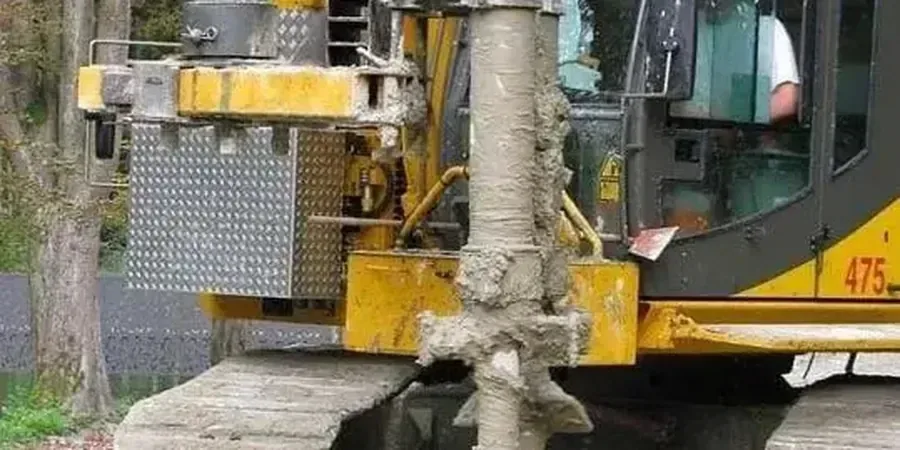
Oakland's Bay Mud can settle up to 0.5 m under load — deep soil mixing reduces that to under 25 mm when designed with site-specific CPT data.
Approach and scope
- Wet method for deep columns (>15 m) in uniform clay
- Dry method for shallow columns in high-moisture peat layers
- Full-scale trial columns verified by core sampling and unconfined compression tests per ASTM D1633
Site-specific factors
ASCE 7-22 classifies most of Oakland as Site Class E (soft soil) due to the Bay Mud layer. This directly controls the seismic design response spectrum. If deep soil mixing doesn't achieve a uniform stiffness across the treatment zone, the structure can experience differential settlement or even tilting during an earthquake. The 1989 Loma Prieta earthquake caused widespread liquefaction-related damage in Oakland's Marina District — a clear reminder that untreated soft ground is a liability. Our design process includes a phased verification program: trial columns, core recovery logging, and unconfined compression tests at 7, 14, and 28 days. We also run numerical settlement analyses using modulus values from the treated soil to confirm post-construction performance under design loads.
Relevant standards
ASCE 7-22 (Chapter 20 — Site Classification for Seismic Design), IBC 2024 (Section 1806 — Deep Foundations / Improvement), ASTM D1633 (Standard Test Method for Compressive Strength of Molded Soil-Cement Cylinders), FHWA-HRT-13-046 (Deep Mixing for Embankment and Foundation Support)
Related technical services
DSM Design with Trial Column Verification
Full design package including binder selection, column layout optimization for Bay Mud conditions, and field verification via trial columns. We specify wet or dry method based on ground conditions and project loads. Core samples are tested for unconfined compression and permeability at 28 days.
Seismic Improvement Analysis
Site-specific response analysis using treated soil modulus values. We model the improved ground under design earthquake motions per ASCE 7-22. Output includes expected settlement, lateral displacement, and factor of safety against liquefaction for the treated zone.
Typical parameters
FAQ
How much does deep soil mixing design cost in Oakland?
For a typical Oakland residential or commercial site, the design fee ranges between US$1,930 and US$6,980. The final cost depends on project size, number of trial columns required, and whether seismic analysis is included. We provide a fixed-price quote after reviewing the geotechnical report and foundation loads.
How deep can deep soil mixing treat Oakland's Bay Mud?
With modern high-torque rigs we can treat down to 30 meters in Oakland. The Bay Mud layer is generally 20 to 60 meters thick, so the practical limit is set by the rig's torque capacity and the required column diameter. For depths beyond 30 m we recommend combining DSM with other Improvement methods.
Do I need a trial column before full-scale DSM production?
Yes — we always require a trial column program for Oakland projects. The Bay Mud's high water content and organic content make it variable. A trial column at the actual site, cored and tested at 7, 14, and 28 days, confirms the design strength and allows us to adjust the binder dosage if needed. This step is standard practice per FHWA guidelines.