Oakland’s proximity to San Francisco Bay means the water table sits high and the soils are predominantly young bay muds, soft clays, and loose sands. These conditions change block by block, from the flatlands near the estuary to the steeper alluvial fans in the hills. A jet grouting design that works for a site in Jack London Square will likely fail at a site in the Dimond District. That is why we never apply a cookie-cutter approach. Every column diameter, every grout mix, every injection pressure is calculated from site-specific soil data. We start by reviewing existing borings and may recommend a complementary [MASW survey](/masw-vs30/) to map stiffness variability across the footprint. The goal is a Improvement scheme that controls settlements and provides uniform bearing for the proposed structure.
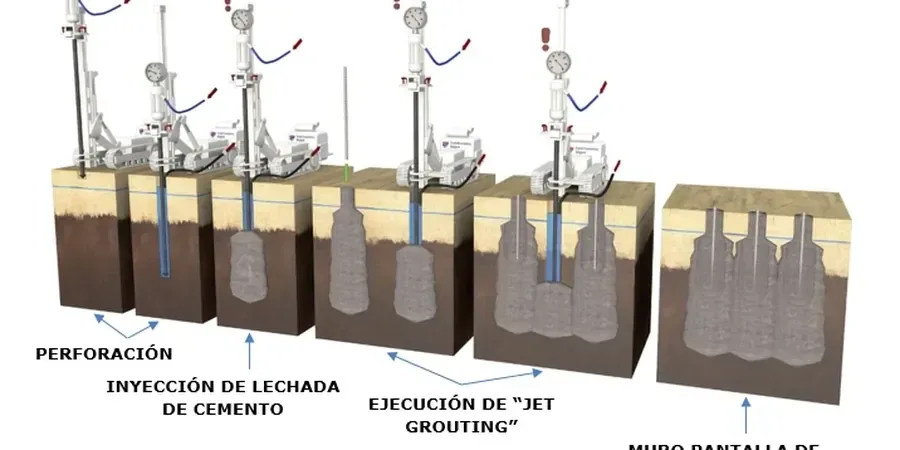
Jet grouting columns designed for Oakland’s bay muds reach design strengths of 0.5–2.0 MPa with diameters up to 2.4 m.
Approach and scope
Site-specific factors
A common mistake contractors make in Oakland is assuming jet grouting produces uniform columns regardless of soil layering. The reality is that a column crossing from soft clay into a sand lens will neck or flare unpredictably if the design pressure is not adjusted for each stratum. We have seen projects where columns designed for 1.2 m diameter ended up at 0.7 m in the sand layers, leaving untreated gaps. That is why we model the injection process for each soil unit and specify a stepwise pressure profile. The design also includes a verification program with coring or excavation of trial columns before full production begins. This approach avoids rework costs that can reach six figures on a large site.
Relevant standards
ASCE 7-22 (seismic load combinations), IBC 2021 Chapter 18 (soils & foundations), ASTM D1586-18 (SPT), FHWA Geotechnical Engineering Circular No. 8 (Improvement)
Related technical services
Jet grouting design for new foundations
We design bottom-feed mono-fluid and double-fluid columns to create a competent bearing stratum under new footings, mats, or raft slabs. The analysis includes column spacing, overlap, and strength verification against the factored loads from the structural engineer. Suitable for mid-rise buildings, bridge abutments, and tank foundations.
Jet grouting design for underpinning & excavation support
For projects adjacent to existing structures or below the water table, we design jet grout panels or blocks that act as a temporary retaining wall and a permanent seepage cutoff. The design addresses lateral earth pressures, hydrostatic uplift, and the allowable deflection limits of the adjacent property. Common along the Broadway transit corridor and near BART tunnels.
Typical parameters
FAQ
How much does a jet grouting design study cost in Oakland?
A full jet grouting design study typically ranges between US$1,680 and US$6,600 depending on the number of columns, site complexity, and whether verification testing is included. This covers soil data review, pressure profiling, column layout, and a quality control plan. Contact us for a quote tailored to your project scope.
What soil conditions in Oakland require jet grouting?
Jet grouting is most commonly specified for soft bay muds, loose hydraulic fills, and interbedded sands found in the flatlands and former marsh areas. These soils have low bearing capacity and high liquefaction potential. The treatment improves strength to 0.5–2.0 MPa and reduces permeability, making it ideal for support of shallow foundations or excavation bottoms.
How deep can jet grouting be applied in Oakland?
Practical treatment depths reach 25 meters with mono-fluid equipment and up to 30 meters with double-fluid systems. Beyond that, production rates drop and column diameter becomes harder to guarantee. For deeper Improvement we typically recommend deep soil mixing or a combination of both methods.
Is jet grouting design affected by Oakland's seismic requirements?
Yes, Oakland is in Seismic Design Category D or E per IBC 2021. The jet grouting design must consider the design earthquake acceleration, the site class, and the liquefaction potential of the native soil. We calculate the improved ground's modulus and check it against the seismic drift and settlement limits required by the structural engineer.
What quality control tests are included in the design?
The design package specifies trial columns, unconfined compression tests on cores, and permeability tests. We also recommend the excavation of at least one trial column to verify diameter and continuity. For critical structures, crosshole sonic logging or thermal profiling can be added to detect defects.