Soil conditions between the Oakland Hills and the flatlands near the estuary differ significantly. The hills expose residual claystone and shale, while the alluvial plain contains soft bay mud and silty sands. For earthwork projects in either area, compaction control is critical. We apply the Proctor test to determine the maximum dry density and optimum moisture content for each soil type. This data guides on-site compaction specifications. Before any structural fill is placed, we recommend correlating Proctor results with a densidad de cono de arena field test to verify achieved compaction against the laboratory target.
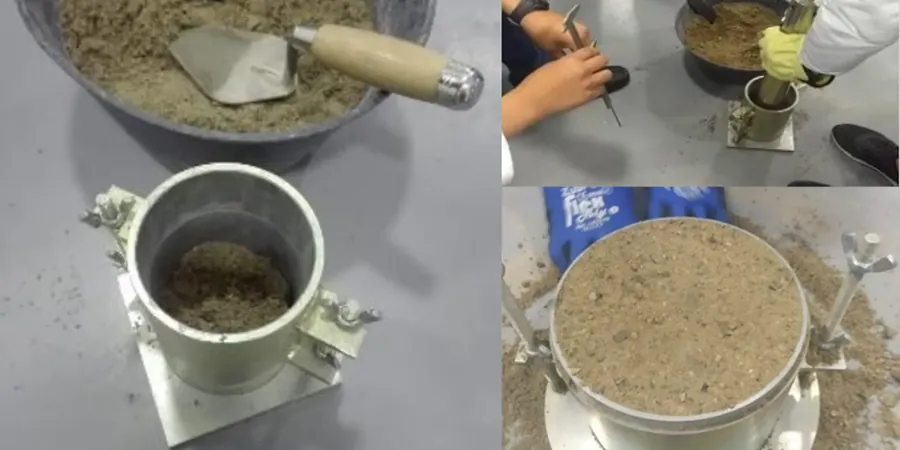
In Oakland's variable soils, the Proctor test is the baseline for compaction specs: it tells you the target density and the moisture window to achieve it.
Approach and scope
Site-specific factors
Oakland sits within a seismically active region where the Hayward Fault runs along the eastern base of the hills. Loose fills and uncompacted soils amplify ground motion and are prone to liquefaction during shaking. A poorly compacted fill — especially on sloping hillside lots — can settle differentially or lose shear strength under seismic loading. The Proctor test establishes the compaction standard needed to achieve a dense, non-liquefiable fill. In our experience, fills at 95% of Modified Proctor maximum dry density show significantly lower settlement and higher cyclic resistance than those compacted to lower standards.
Service video
Relevant standards
ASTM D698 — Standard Proctor, ASTM D1557 — Modified Proctor, ASTM D2487 — Unified Soil Classification System, Caltrans Standard Specifications (Section 19)
Related technical services
Standard Proctor (ASTM D698)
Standard 5-point compaction curve for earthwork control on residential fills, shallow utility trenches, and low-volume road subgrades.
Modified Proctor (ASTM D1557)
Higher compactive effort for structural fills, deep embankments, and Caltrans-specified highway projects where higher density is required.
Multi-Point Moisture-Density Curve
Full curve with 5 to 8 points to define the optimum moisture content precisely, especially for soils with high plasticity or fines content.
Field Compaction Verification
Correlation of lab Proctor results with field density tests (sand cone or nuclear gauge) to confirm that placed fill meets specification.
Typical parameters
FAQ
What is the difference between Standard and Modified Proctor in terms of cost?
The Standard Proctor (ASTM D698) typically ranges between US$80 and US$150 per test. The Modified Proctor (ASTM D1557) runs from US$120 to US$220 per test, reflecting the higher compactive effort and additional material handling. Volume discounts apply for multiple samples from the same project.
Do I need Standard or Modified Proctor for my Oakland project?
It depends on the expected compaction equipment and fill type. Standard Proctor is adequate for light to moderate compaction, such as residential backfill. Modified Proctor is recommended for highway embankments, deep fills, and any structural fill that will be compacted with heavy rollers. The geotechnical engineer on your project will specify which standard applies based on the design requirements.
How long does a Proctor test take to complete?
A complete Proctor test — including sample preparation, moisture-density determination, and curve plotting — typically takes 2 to 3 business days. Rush turnaround (next business day) is available for an additional fee. The timeline depends on the number of points requested and whether the sample requires drying or sieving first.