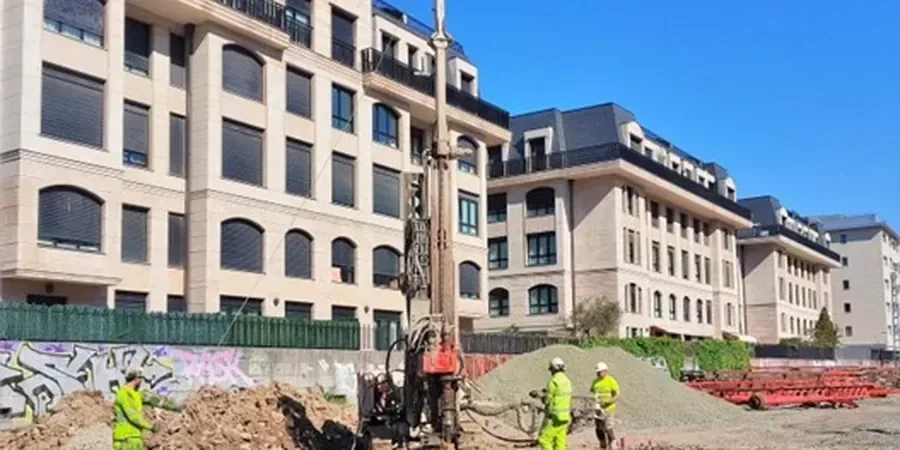
A crawler-mounted drill rig sets up on a tight Oakland street. The mast extends between parked cars and overhead wires. The crew assembles the first casing section. They thread it through the topsoil and into the Franciscan Complex bedrock beneath. This is micropile design in action. Oakland's geology demands a system that transfers load through fill, colluvium, and fractured sandstone. The team uses a duplex drilling method to avoid destabilizing adjacent foundations. Before drilling begins, they review the site-specific geotechnical parameters from the study of soil mechanics report. Each pile location is marked and surveyed. The grout mix is batched on site and tested for compressive strength at 7 and 28 days.
A 7-inch cased micropile grouted at 0.45 w/c can carry over 100 kips in the Franciscan Complex bedrock of Oakland.
Approach and scope
Site-specific factors
Hillside Oakland and flatland Oakland behave like two different cities. In the Rockridge district, homes sit on a thin layer of colluvium over weathered sandstone. In the flatlands near the estuary, soft Bay Mud can extend 80 feet deep. Micropile design must respond to each setting. On the hills, the risk is liquefaction of the loose fill during a seismic event. A micropile bedrock socket prevents differential settlement. In the flatlands, the risk is negative skin friction from consolidating clay. The design includes a permanent casing through the soft layers to shed the downdrag load. The engineer checks the pile group interaction for a 475-year seismic event per ASCE 7-22.
Relevant standards
IBC 2021 Chapter 18 (Soils and Foundations), ASCE 7-22 (Minimum Design Loads), ASTM A722 (High-Strength Steel Bar), FHWA-NHI-05-039 (Micropile Design and Construction)
Related technical services
Seismic Retrofit Micropiles
Brace existing foundations in Oakland's older buildings. We design micropiles that tie into the existing footing and transfer lateral loads to competent strata. Each pile is proof-tested to 150% of design load.
New Construction Micropiles
Support new residential or commercial structures on Oakland's variable terrain. The design includes group efficiency analysis and settlement verification. We provide stamped calculations for permit submittal.
Typical parameters
FAQ
What is the typical cost range for micropile design in Oakland?
The design engineering fee typically falls between US$1,590 and US$3,950 for a standard residential project. The cost depends on the number of piles, soil conditions, and required load testing. Structural peer review and permit fees are separate.
How deep do micropiles need to go in Oakland's hillside soils?
The micropile must socket into competent bedrock or very dense soil. In the Oakland hills, the bond zone typically starts 15 to 25 feet below the surface, where the Franciscan Complex sandstone or melange is encountered. The length is confirmed during installation by monitoring the drilling return and torque.
Can micropiles be installed inside an existing Oakland basement?
Yes. The equipment can fit through a standard residential doorway. The drill rig is modular and assembled on site. We use a low-headroom mast that operates in spaces as tight as 8 feet. The grout plant stays outside and pumps the mix through a hose.
What is the difference between a micropile and a conventional driven pile in Oakland?
A driven pile displaces soil and can cause vibration damage to adjacent structures. A micropile is drilled with a casing that removes the spoil. This makes it suitable for Oakland's dense urban lots. The micropile also carries load in tension and compression, which is critical for seismic retrofit.