A common mistake we see in Oakland hillside projects is assuming a uniform soil profile. Contractors often design retaining systems based on surface conditions alone. That works until the wet season hits. Oakland’s Franciscan Complex mélange creates highly variable bedrock conditions, with sheared zones and weak clay seams that can shift without warning. A proper slope stabilization design must account for these local anomalies. We routinely pair subsurface exploration with georradar GPR to map hidden fractures before any excavation begins. It saves time and avoids costly mid-project redesigns.
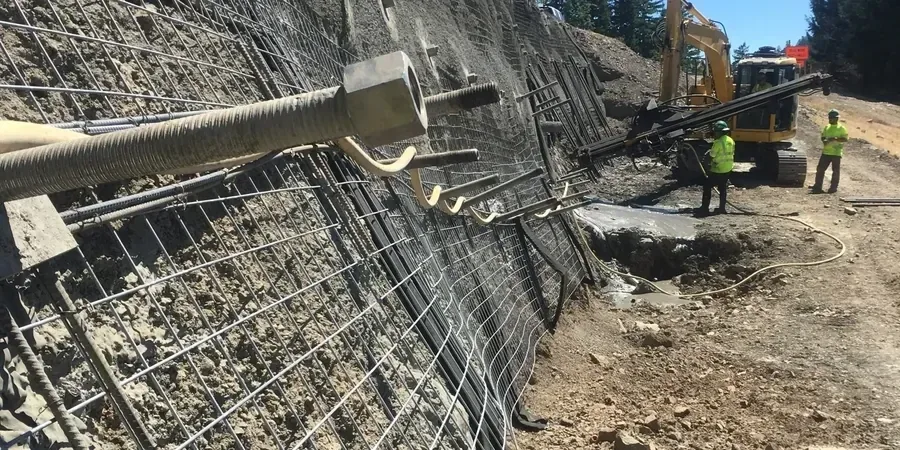
Oakland’s Franciscan Complex mélange creates sheared zones and weak clay seams that can shift without warning—surface data alone is never enough.
Approach and scope
- Borehole logging and SPT per ASTM D1586
- MASW surveys for shear-wave velocity profiles
- Triaxial CU tests on undisturbed samples
Site-specific factors
Compare the soils in Oakland’s Claremont district with those in the flatlands near the estuary. The hillside clays are collapsible and prone to creep, while the bay muds near Jack London Square require deep foundations. A single slope stabilization design cannot serve both. Without site-specific testing, you risk sliding along a pre-existing shear zone. We’ve seen 70-foot cuts fail during January rains because the design assumed drained conditions that never materialized. That is why we run consolidation tests on every clay sample from Oakland hillside sites.
Relevant standards
FHWA-NHI-05-089 (Slope Stability Reference Manual), ASCE 7-16 (Minimum Design Loads for Buildings), ASTM D4767 (Consolidated Undrained Triaxial Test), IBC 2021 Chapter 18 (Soils and Foundations)
Related technical services
Limit-Equilibrium & Finite-Element Analysis
We model circular, wedge, and block failure surfaces using software validated against case histories from the Oakland hills. Results include critical slip surfaces, required reinforcement forces, and groundwater sensitivity.
Rock Slope & Soil Nail Wall Design
For cuts in Franciscan sandstone or fractured shale, we design soil nail walls, rock bolts, and shotcrete facings. Each design is checked for seismic displacement and drainage capacity.
Typical parameters
Service video
FAQ
What is the typical cost range for a slope stabilization design in Oakland?
The cost for a full slope stabilization design in Oakland ranges between US$1.440 and US$7.180, depending on site complexity, number of borings, and required laboratory testing.
How deep do borings need to be for hillside projects in Oakland?
Borings should extend at least 10 to 15 feet below the anticipated failure surface, or to refusal in bedrock. In the Oakland hills, we often drill 40 to 60 feet to reach competent Franciscan sandstone.
Which soil parameters are most critical for slope stability analysis?
Effective cohesion (c), effective friction angle (phi), and unit weight are the primary inputs. For seismic cases, the shear-wave velocity (Vs30) also influences the site class and pseudo-static coefficient.
Do you include drainage design as part of the stabilization package?
Yes. We always include drainage measures—horizontal drains, weep holes, or trench drains—because groundwater buildup is the most common trigger for slope failures in Oakland’s wet winters.
Can you design a slope stabilization for a lot that has already cracked?
Yes, but we must first install inclinometers and piezometers to measure ongoing movement and pore pressure. The design then addresses the active failure mechanism, often combining unloading with soil nails or tiebacks.