Oakland grew rapidly after the 1906 earthquake, with fill placed over tidal flats and marshlands along the estuary. These soft Holocene clays and organic silts dominate the subsurface below much of the downtown and port areas. The undrained shear strength of these deposits is critical for foundation design and slope stability assessments. We perform the field vane shear test (VST) to measure in-situ undrained shear strength directly, avoiding sample disturbance that plagues soft clays. Before relying on VST results for bearing capacity, many engineers also require a compression test on intact samples for cross-validation. The test follows ASTM D2573 and provides rapid, reliable data for embankments, excavations, and shallow foundations in Oakland.
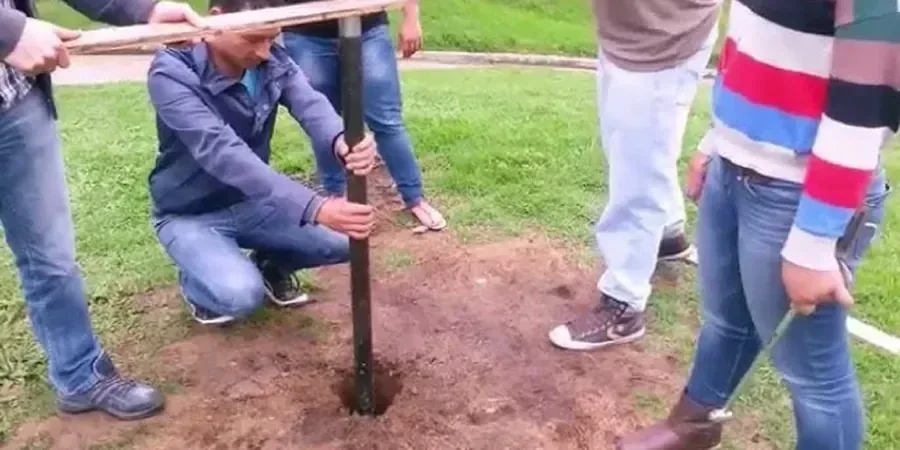
The field vane shear test measures undrained shear strength in soft clays where sample disturbance would otherwise invalidate lab results.
Approach and scope
Site-specific factors
Oakland sits within a high seismic zone with a peak ground acceleration of 0.6g per ASCE 7-22. The 1989 Loma Prieta earthquake caused widespread liquefaction and lateral spreading in the fill soils near the Port of Oakland. Soft clays with low undrained shear strength can undergo cyclic softening and strength loss during shaking. VST data allows us to evaluate post-earthquake residual strength for stability analyses. When combined with slope stability modeling and site response studies, the VST results help engineers design Improvement or deep foundations that perform through the next major event. Ignoring the true in-situ strength of Oakland's soft clays leads to overly conservative or unsafe designs.
Service video
Relevant standards
ASTM D2573-18 (Standard Test Method for Field Vane Shear Test in Saturated Fine-Grained Soils), ASCE 7-22 (Minimum Design Loads and Associated Criteria for Buildings and Other Structures), IBC 2021 (International Building Code, Chapter 18 – Soils and Foundations), Caltrans Geotechnical Manual (2023)
Related technical services
VST in Bay Mud Deposits
Targeted testing in the thick Bay Mud layers beneath downtown and the estuary, providing undrained shear strength profiles for embankment and foundation design.
Sensitivity and Remolded Strength
Remolded VST at the same depth to quantify sensitivity, critical for evaluating liquefaction potential and post-peak strength loss in soft clays.
Multi-Depth Profiles
Continuous VST at 1.5 m intervals from surface to 30 m, correlated with adjacent borings to build a reliable strength model for the site.
VST for Slope Stability
VST data used directly in limit equilibrium analyses for levees, channel banks, and natural slopes under static and seismic conditions.
Typical parameters
FAQ
How does the field vane shear test differ from a lab triaxial test for Oakland clays?
The VST measures undrained shear strength in situ, avoiding sample disturbance common in soft Bay Mud. Lab triaxial tests on intact samples often underestimate strength due to handling effects. VST gives a more reliable peak and residual value for design.
What is the typical cost range for a VST program in Oakland?
For a standard site with 5 to 8 test locations, the cost ranges between US$670 and US$1,320. This includes mobilization, vane insertion, data acquisition, and a summary report with corrections. Volume discounts apply for larger projects.
How deep can the VST reach in Oakland's soft soils?
With standard AW rod and hydraulic push, we reach 30 m in most Bay Mud and clay deposits. For deeper zones, we use heavy-duty rods and a drill rig. Maximum depth depends on rod buckling resistance and soil stiffness.
Is the VST suitable for stiff clays or sands?
No. The VST is designed for soft to medium clays and silts with undrained shear strength below 200 kPa. In stiff clays or sandy soils, the vane may tear or rotate without measuring meaningful torque. We recommend SPT or CPT for those materials.