Oakland sits on a complex mix of alluvial deposits, Franciscan Complex bedrock, and artificial fill along the waterfront, with elevations ranging from sea level at Jack London Square to over 500 feet in the Oakland Hills. This geological patchwork means pavement design here cannot rely on textbook values. We have seen new subdivisions in East Oakland fail within three years because the subgrade was treated as uniform when in fact collapsible soils and old creek channels created drastic variations in support. Before specifying asphalt thickness or concrete slab design, we always run a full program of CBR testing and dynamic cone penetration to map subgrade variability. For projects along the former estuary alignments, we often combine this with georradar surveys to detect buried organic layers that would otherwise cause differential settlement under traffic loads.
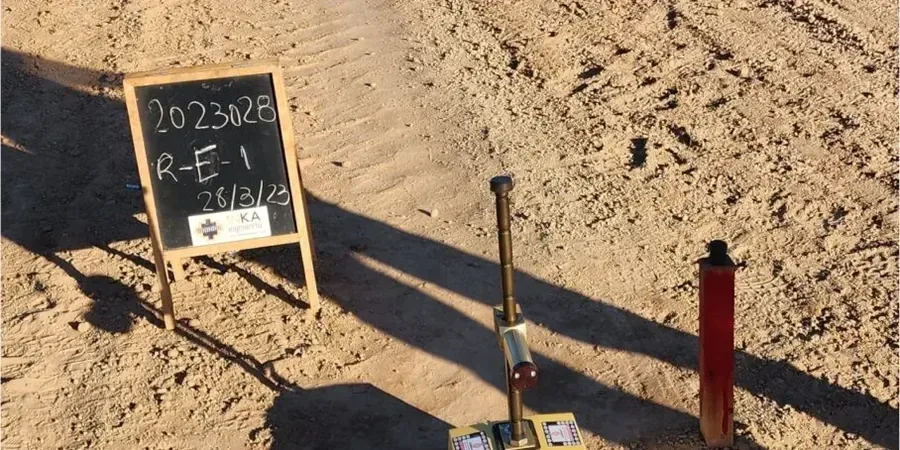
Subgrade CBR in Oakland ranges from 2 percent in bay mud near the Port to over 25 percent on residual soils in the upper hills, demanding site-specific pavement design for every block.
Approach and scope
Site-specific factors
A common mistake we see among contractors in Oakland is assuming that a single CBR test from a test pit at the property corner is representative of the entire site. On a recent parking lot project near Coliseum BART, the designer used a CBR of 8 percent from one location, but three other test pits showed values as low as 2.5 percent in old marsh deposits. The pavement cracked within the first rainy season. The real risk is not just cracking: differential subgrade support under a rigid pavement causes slab curling and pumping of fines, which can lead to complete structural failure in less than five years. We always insist on at least one CBR test per 500 square meters in Oakland's flatlands, with additional tests wherever the soil log shows a change in texture or color.
Relevant standards
ASTM D1883 (CBR), AASHTO T-193 (CBR), ASTM D698 / D1557 (Proctor compaction), AASHTO M 145 (AASHTO soil classification for pavements), ASTM D4318 (Atterberg limits – plasticity index for subgrade)
Related technical services
Subgrade Investigation & CBR Testing
We perform test pits and boreholes with field CBR testing using the dynamic cone penetrometer and laboratory soaked CBR per ASTM D1883. For each soil unit we determine the design California Bearing Ratio, classify the material under AASHTO M 145, and measure swell potential on expansive clays common in Oakland's hill areas.
Pavement Structural Section Design
Using the subgrade modulus (MR) derived from CBR and resilient modulus testing, we design flexible asphalt sections with the AASHTO 1993 empirical method and rigid concrete sections with PCA/ACPA procedures. We incorporate Oakland-specific factors such as shallow groundwater in the flatlands and frost action in the upper hills.
Subgrade Stabilization Recommendations
When subgrade soils fall below the required CBR (typically under 5 percent for medium traffic), we evaluate mechanical stabilization with geotextiles, cement or lime treatment, and granular replacement. For Oakland's bay mud areas we often recommend cement-treated subgrade layers to achieve a uniform modulus across the pavement footprint.
Typical parameters
FAQ
What CBR value is typically required for a residential street in Oakland?
For local residential streets in Oakland with low traffic volumes (less than 100 vehicles per day), we typically look for a soaked CBR of at least 6 percent for the upper 300 mm of subgrade. If the natural soil yields lower values, we recommend a 200-mm cement-treated subgrade layer to bring the effective modulus up to design requirements. The final decision depends on the pavement structural number calculated from traffic loading.
How much does a road geotechnics study for pavement design cost in Oakland?
A typical pavement subgrade investigation for a single-family lot in Oakland runs between US$780 and US$4.730 depending on the number of test pits, CBR tests, and laboratory compaction curves required. For a full subdivision or commercial parking lot, the cost scales with the number of test locations and the complexity of the soil profile. We recommend contacting our office with the project area and traffic data for a precise scope.
Do I need a separate seismic site class study for pavement design in Oakland?
Not necessarily for the pavement itself, but if your project includes retaining walls, bridges, or buried utilities, the IBC requires a seismic site class per ASCE 7 based on VS30 or N-value from SPT. We often run the pavement subgrade investigation concurrently with a MASW survey for site class, which saves mobilization costs. For pavement-only projects on flatland sites, the subgrade modulus already accounts for the static loading conditions.
What is the difference between CBR and resilient modulus (MR) for pavement design?
CBR is a penetration test that measures the shear resistance of a compacted soil under controlled moisture conditions, used primarily for the AASHTO empirical design method. Resilient modulus (MR) is a cyclic triaxial test that simulates the elastic response of the subgrade under repeated traffic loads. For Oakland projects with heavy truck traffic (e.g., near the Port), we recommend MR testing because it provides a more realistic modulus for mechanistic-empirical pavement design. A common correlation is MR (psi) = 1500 × CBR for fine-grained soils, but this can overestimate stiffness in highly plastic clays.