Oakland sits on a mix of Bay Mud and alluvial fans from the hills. In West Oakland, the soft clay layer can exceed 15 meters. Near the Oakland Hills, residual soils over Franciscan bedrock dominate. That contrast changes foundation design completely. A soil mechanics study separates those two worlds. It gives us the numbers we need to recommend shallow footings or deep piles. We also correlate blow counts with undrained shear strength using a compression test to confirm bearing capacity. Without this study, you are guessing. And guessing on Bay Mud is expensive.
Bay Mud can settle 30 cm under a moderate load. A soil mechanics study predicts that before you pour concrete.
Approach and scope
Site-specific factors
Oakland's urban development since the 1900s filled tidal flats with loose material. Those artificial fills settle unevenly and can liquefy during a seismic event. The 1989 Loma Prieta earthquake caused lateral spreading in the flatlands. A soil mechanics study identifies zones with high liquefaction potential. We run cyclic triaxial tests and apply the NCEER method. You want to know if your building sits on fill or natural ground. That decision starts in the lab.
Relevant standards
ASTM D1586-18 (Standard Penetration Test), ASTM D2487-17 (Unified Soil Classification), ASCE 7-22 (Site Class & Seismic Design), ASTM D2435-20 (One-Dimensional Consolidation)
Related technical services
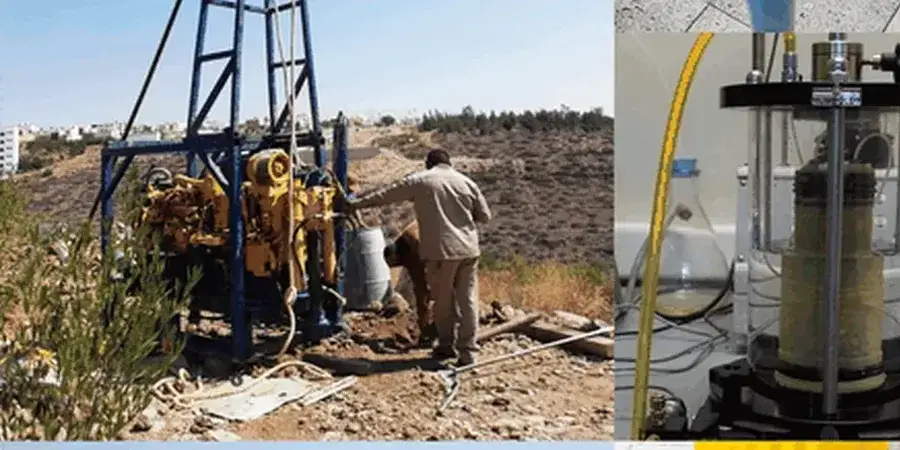
Field Sampling & SPT
Boreholes with standard penetration tests every 1.5 m. We log blow counts, collect disturbed and undisturbed samples. Split-spoon and thin-wall tubes.
Laboratory Testing Suite
Gradation, Atterberg limits, Proctor compaction, triaxial compression, and consolidation. All tests follow ASTM procedures with NATA-accredited equipment.
Geotechnical Interpretation Report
We integrate field and lab data to produce bearing capacity, settlement estimates, site class, and liquefaction assessment. Ready for your structural engineer.
This service complements our laboratory testing work for a complete project analysis.
Typical parameters
FAQ
How long does a soil mechanics study take in Oakland?
Most projects finish in 2 to 3 weeks. Field work takes 1 to 2 days depending on borehole depth. Lab testing runs 7 to 10 days. Consolidation tests need more time because clay drains slowly.
What is the cost of a soil mechanics study for a single-family lot?
A standard study for a residential lot ranges between US$3.020 and US$4.540. That covers two boreholes, SPT logging, lab testing, and a written report. Deeper holes or additional borings increase the cost.
Do I need a soil mechanics study for a small addition or ADU?
Yes, if the addition exceeds 50 m² or requires a new foundation. Oakland building code follows IBC. A geotechnical report confirms site class and bearing capacity. Without it, you may not get a permit.