The fog rolls in over the Oakland hills and the temperature drops fast. That marine layer keeps the ground moist year-round, which directly affects how seismic waves behave in the upper soil column. We run MASW surveys here precisely because the near-surface velocity profile is so variable across Oakland. It is not enough to guess the site class from a boring log. The shear wave velocity measured with a multichannel array gives us a continuous 2D profile down to 30 meters. That VS30 value is what ASCE 7 uses to assign the site class. We have seen parcels in the flatlands where Bay mud produces a VS30 below 180 m/s, while a few blocks into the hills the Franciscan bedrock pushes it above 760 m/s. That contrast is exactly why we deploy the MASW spread before any foundation design. It is fast, non-invasive, and gives the engineer a defensible number for the seismic coefficient. In Oakland, where the Hayward Fault runs through the eastern edge, you need that number to be right.
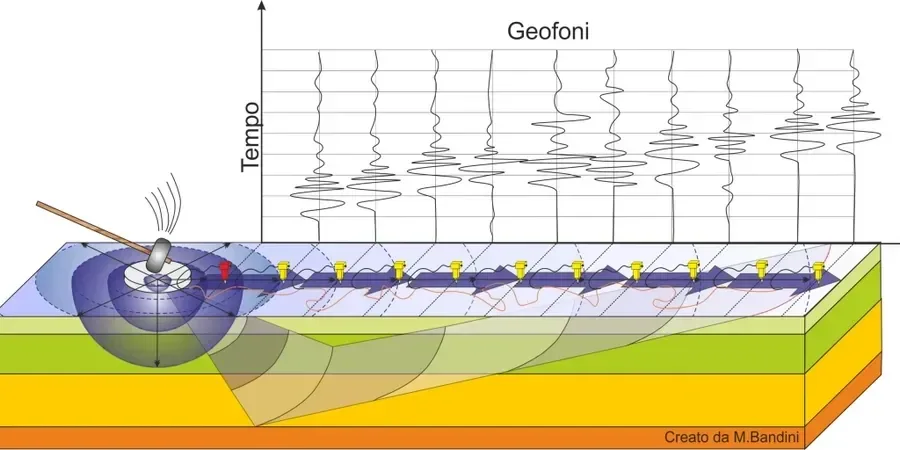
In Oakland, where the Hayward Fault runs through the eastern edge, you need that VS30 number to be right.
Approach and scope
The workflow is straightforward:
- Place the geophone land streamer, couple it with the base plate.
- Generate a sledgehammer source at each end and mid-point.
- Record 4-second windows with a 24-bit seismograph.
- Pick the fundamental mode Rayleigh wave dispersion curve.
- Invert using a genetic algorithm to get the shear wave velocity profile.
Site-specific factors
The Hayward Fault is a creeping fault, meaning it moves a few millimeters every year without large earthquakes. But the accumulated strain is released in magnitude 6.5 to 7.0 events every 140 years on average. The last one was 1868. Oakland sits directly on the fault trace in the eastern hills, and the flatlands are underlain by soft Bay muds that amplify long-period shaking. The biggest risk we see is site amplification combined with liquefaction in the sandy lenses within the mud. A VS30 below 240 m/s tells us the site is in the NEHRP E zone. That means the design spectrum is wider and the base shear is higher. If the building is on a mat foundation, the risk of edge settlement increases. We have seen projects where the owner saved money by skipping the MASW. Then the structural engineer assumed a stiffer site class. The result was a building that swayed more than predicted during the 2014 Napa earthquake. That sway cracked partition walls and damaged the elevator shaft. The repair cost exceeded the geotechnical budget ten times over.
Relevant standards
ASTM D4428/D4428M - Standard Test Method for Crosshole Seismic Testing, ASCE 7-22 Chapter 20 - Site Classification for Seismic Design, NEHRP Recommended Provisions (FEMA P-1050) - Site Class Definitions, IBC 2021 Section 1613 - Seismic Ground Motion Values
Related technical services
MASW Survey (Active Source)
Multichannel analysis of surface waves using a 24- or 48-channel seismograph and sledgehammer source. The dispersion curve is inverted in real time to produce a 1D shear wave velocity profile every meter along the line. Ideal for footprint-scale investigations in Oakland's variable geology.
VS30 Site Classification Report
We calculate the time-averaged shear wave velocity to 30 meters depth and assign the ASCE 7 site class (A through F). The report includes the raw dispersion curves, inversion statistics, and a final VS30 value with uncertainty bounds. Used directly in structural design spectra.
Passive MASW (Microtremor Array)
In urban Oakland where active source noise is high, we deploy a circular array of 10 to 15 three-component seismometers. The ambient vibration is processed with the SPAC method to resolve deeper velocity structure down to 100 meters. Useful for tall buildings and bridge foundations.
Typical parameters
FAQ
What is the difference between MASW and a standard SPT boring for site classification?
A standard SPT boring gives you blow counts and soil samples at discrete depths, typically every 1.5 meters. But it does not measure shear wave velocity directly. MASW measures the velocity profile continuously from the surface to 30 meters or deeper. The VS30 value derived from MASW is exactly what ASCE 7 requires for site class assignment. A boring can miss a stiff layer below the termination depth, or a soft layer that was not sampled. MASW sees the whole column. In Oakland, where Bay mud overlies stiff sand over bedrock, the velocity profile can switch from 150 m/s to 600 m/s in a few meters. Only the MASW captures that transition.
How much does a MASW and VS30 survey cost in Oakland?
The typical cost for a residential or small commercial site in Oakland ranges between US$1,460 and US$2,730. That includes one day of field work with a 48-channel system, the inversion processing, and a sealed report with the VS30 value and site class. Larger sites with multiple arrays or passive microtremor measurements can go higher. The price depends on the number of lines, the array length, and whether you need passive MASW for deeper structure. We always provide a fixed quote before mobilizing.
Can MASW be used on a site with fill or underground utilities?
Yes, but with some care. Fill material usually has a low shear wave velocity, often below 200 m/s, which can mask the underlying stiff soil. The MASW dispersion curve will pick up the fill as a low-velocity layer. That is actually useful because you need to know the fill thickness for both site class and liquefaction evaluation. Underground utilities like water mains or gas lines create a high-velocity anomaly that can distort the dispersion curve. We walk the entire line with a utility locator before deploying the geophones. If we see a pipe crossing the array, we shift the line by 2 meters. The inversion algorithm handles small lateral heterogeneities, but a large void or a concrete pipe can give a false high-velocity reading.