For projects in Oakland, sheet pile wall design must comply with IBC Chapter 18 and ASCE 7-22, especially when dealing with soft bay mud and high groundwater along the estuary. The interlocking steel sections rely on accurate soil parameters — unit weight, friction angle, and cohesion — that we obtain through field tests like the ensayo SPT to define the N-value profile. Because Oakland sits in Seismic Zone 4, our designs also incorporate liquefaction-induced lateral pressures using the NCEER method from Youd and Idriss (2001). The result is a wall that resists both static earth pressure and cyclic loads from earthquakes, a requirement that becomes non-negotiable near the Oakland-Alameda shoreline.
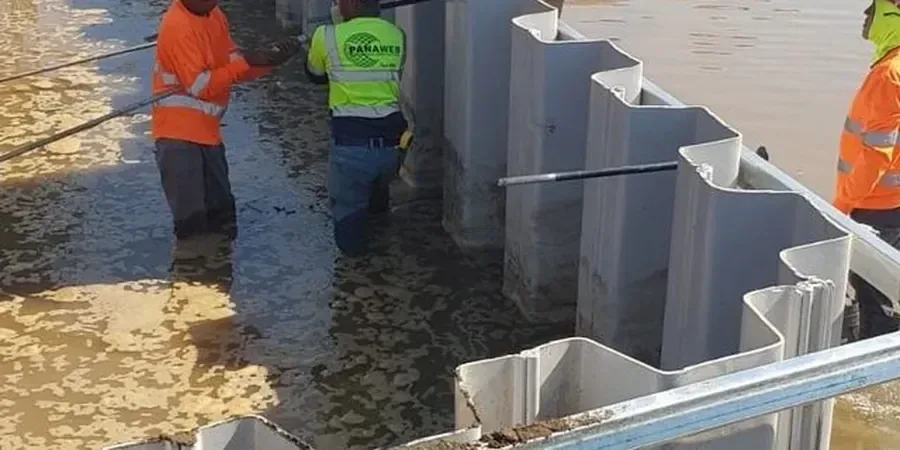
In Oakland, the transition from soft bay mud to stiff alluvium over 15 meters forces sheet pile designs to account for sudden stiffness changes and high lateral loads.
Approach and scope
Site-specific factors
Compare a site in the Oakland Estuary with one in the Dimond District. Along the estuary, the top 12 meters are soft bay mud with organics, requiring sheet piles driven to refusal in the underlying dense sand. The risk? Lateral squeeze during driving can displace adjacent bulkheads. Up in Dimond, you hit weathered shale at 6 meters — a different challenge entirely: hard driving conditions that risk pile buckling and interlock separation. In both cases, the absence of a proper sheet pile wall design leads to collapse of the excavation, damage to neighboring utilities, and costly delays. We have seen walls fail because the designer assumed uniform soil conditions across Oakland — a mistake that ignores the city's complex geology.
Relevant standards
IBC 2021, Chapter 18 (Soils and Foundations), ASCE 7-22 (Minimum Design Loads, Seismic), AASHTO LRFD Bridge Design Specifications, Section 11 (Walls), ASTM D1586-18 (Standard Test Method for SPT)
Related technical services
Geotechnical site investigation for sheet piles
Boreholes with SPT and undisturbed sampling to define the strength and stiffness profile for each wall section.
Lateral earth pressure analysis
Liquefaction and lateral spread assessment
Evaluation of cyclic softening in bay mud and loose fill, with quantification of residual lateral loads on the wall.
Anchor and tieback design
Design of grouted anchors, deadman systems, and wale beams to support sheet pile walls in deep excavations.
Typical parameters
FAQ
What is the typical depth of sheet piles in Oakland?
Depths range from 9 to 18 meters depending on the soil profile. In soft bay mud areas near the estuary, piles often reach 15 m to toe into the underlying dense sand or stiff clay. In the hills or alluvial terraces, depths of 9–12 m are common.
How does liquefaction affect sheet pile wall design in Oakland?
Liquefaction of loose fill or saturated sands generates lateral spreading forces that can exceed static earth pressures by a factor of two. Our designs incorporate the NCEER method (Youd and Idriss, 2001) to compute residual loads, and we specify heavier sections or additional anchor rows to resist those forces.
What is the difference between cantilever and anchored sheet pile walls?
Cantilever walls rely solely on the embedded length for stability and are suitable for heights up to 4–5 m. Anchored walls use tiebacks or deadmen to resist higher lateral loads and are required for deeper excavations in Oakland, especially near the estuary where soft soils reduce passive resistance.
Can sheet piles be installed in Oakland's rocky areas?
In areas underlain by Franciscan Complex (Oakland Hills, Piedmont), rock at shallow depth prevents full penetration. Pre-drilling through the rock layer or using H-piles with driven sheet panels may be necessary. A site investigation with core drilling is recommended before specifying the wall type.
How much does sheet pile wall design cost in Oakland?
The cost for geotechnical design and analysis typically ranges from US$1.690 to US$5.120, depending on the wall length, soil complexity, and whether seismic liquefaction analysis is required. This does not include installation, material procurement, or structural detailing of the steel sections.