Oakland's hillsides and varied topography demand rigorous slope stability analysis under ASCE 7 and FHWA-NHI-05 guidelines. The city's location on the Hayward Fault creates unique seismic loading conditions that directly impact factor-of-safety calculations. We combine limit equilibrium methods with finite element modeling to evaluate both static and pseudo-static conditions, ensuring compliance with IBC Chapter 18 requirements. Our approach integrates site-specific geologic mapping and laboratory testing to characterize the Franciscan Complex bedrock and colluvial soils that dominate many Oakland hillside sites. Before finalizing designs, we often recommend a complementary resistivity survey to map subsurface variations or a MASW survey to capture vs30/" data-interlink="1">shear wave velocity profiles for seismic site classification.
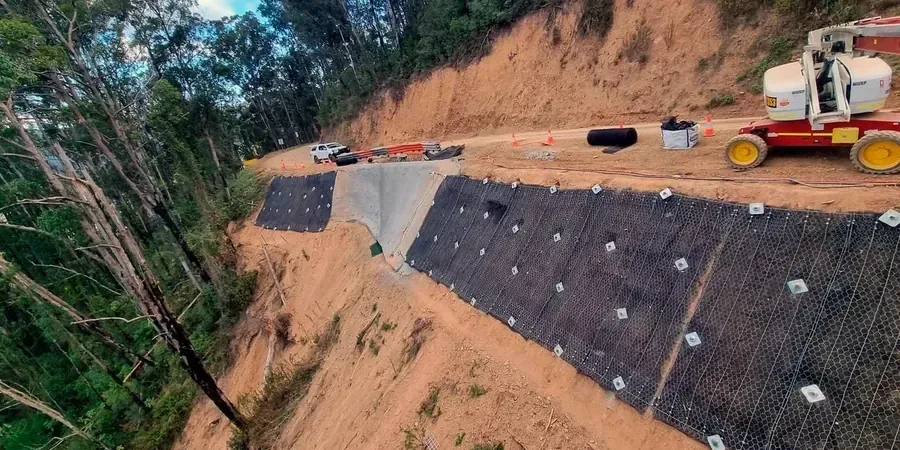
Oakland's hillsides combine steep gradients, Franciscan Complex geology, and high seismic hazard — requiring site-specific stability analysis that standard county maps cannot provide.
Approach and scope
Site-specific factors
The Mediterranean climate of the Bay Area brings a stark contrast between dry summers and wet winters. Oakland receives about 26 inches of annual rainfall, most of it between November and April. That seasonal saturation drastically reduces soil shear strength in the colluvium and residual soils blanketing the hillsides. After heavy storm events, pore pressures rise, effective stresses drop, and previously stable slopes can fail rapidly. Our slope stability analysis accounts for these transient conditions by modeling worst-case phreatic surfaces and using unsaturated soil mechanics where appropriate. We also evaluate the long-term effects of vegetation removal and irrigation from upslope development, which can trigger progressive failure over months or years.
Service video
Relevant standards
ASCE 7-16 (Minimum Design Loads — seismic site class & pseudo-static coefficients), FHWA-NHI-05-089 (Slope Stability Reference Manual), IBC 2021 Chapter 18 (Soils & Foundations — factor of safety requirements)
Related technical services
Preliminary Screening & Reconnaissance
Office-based review of published geologic maps, LiDAR topography, aerial imagery, and historical landslide inventories. Includes site walkover with basic discontinuity measurements for rock slopes. Delivers a qualitative stability rating and recommendations for detailed investigation.
Detailed Limit Equilibrium Analysis
Full subsurface exploration with test pits or borings, laboratory testing (triaxial, direct shear, Atterberg limits), and limit equilibrium modeling using 2-3 cross-sections. Includes both static and pseudo-static analyses. Report provides calculated factors of safety, critical failure surfaces, and recommended mitigation measures.
Advanced Numerical Modeling & Stabilization Design
Finite element or finite difference analysis using PLAXIS or FLAC for complex geometries, weak layers, or existing retaining structures. Incorporates staged construction, groundwater flow, and seismic time-history. Deliverables include reinforcement designs (soil nails, tiebacks, shear keys) and construction monitoring protocols.
Typical parameters
FAQ
When is slope stability analysis required in Oakland?
Oakland Municipal Code requires a geotechnical investigation — including slope stability analysis — for any new construction on slopes steeper than 10:1 (10%), within 50 feet of the top or toe of a slope exceeding 15 feet in height, or in areas identified as landslide-prone on the Alameda County landslide hazard maps. Many lenders also require it for property transactions in hillside districts.
What factor of safety does Oakland building code require?
Under IBC 2021 and ASCE 7-16, the minimum acceptable factor of safety for static conditions is 1.5. For pseudo-static seismic analysis, the minimum is 1.1. Some Oakland hillside districts may impose stricter requirements — up to 1.5 for seismic cases — especially for critical facilities or slopes adjacent to public rights-of-way.
How much does slope stability analysis cost in Oakland?
Pricing typically ranges from US$1,390 for a preliminary screening with desktop review and walkover, up to US$4,420 for a detailed analysis with subsurface exploration, laboratory testing, and full limit equilibrium modeling. Advanced numerical modeling or stabilization design adds to the upper end of that range. Final cost depends on site complexity, number of cross-sections, and laboratory testing requirements.
Can slope stability analysis be done without drilling?
For preliminary screening, yes — desktop studies and walkovers can provide qualitative guidance. But for design-level factor-of-safety calculations, subsurface information is essential. We typically recommend at least 2-3 test pits or borings to characterize soil/rock strength, groundwater conditions, and stratigraphy. In some Oakland hillside sites with Franciscan Complex bedrock, we supplement borings with geophysical surveys like MASW or resistivity to interpolate between boreholes.