A warehouse expansion near the Oakland Estuary required 15 feet of fill on Bay Mud. Without treatment, settlement would exceed 18 inches over two years. The team specified preloading with surcharge design to accelerate consolidation before building. This method uses temporary fill to squeeze pore water from the soft clay, mimicking years of settlement in weeks. For Oakland, where deep deposits of Young Bay Mud underlie much of the flatland, preloading is a proven Improvement technique. The design must account for variable clay thickness, drainage path length, and secondary compression. We integrate lab consolidation tests with field monitoring to verify progress. Before finalizing the surcharge, we often run consolidation tests to determine the compression index and coefficient of consolidation for each soil layer.
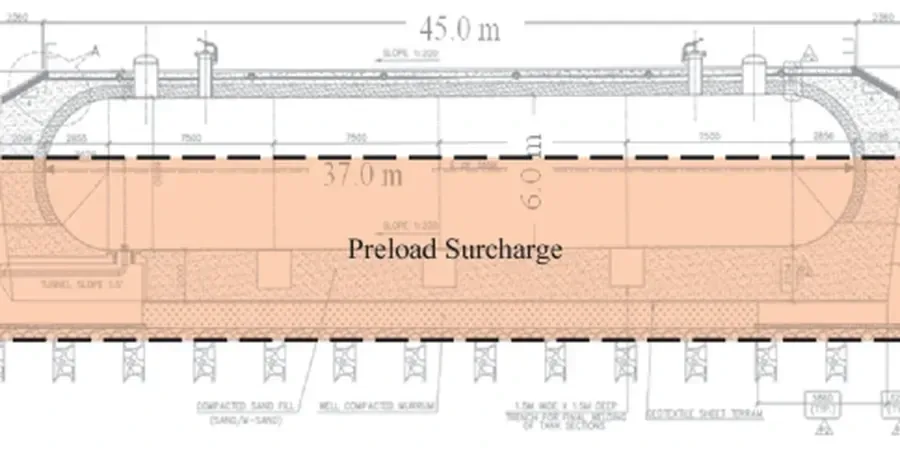
Preloading with surcharge design in Oakland accelerates consolidation of Bay Mud, reducing post-construction settlement by up to 90 percent.
Approach and scope
Site-specific factors
Oakland sits at 43 feet above sea level, but its flatland districts like Jack London Square rest on up to 80 feet of Young Bay Mud. This soft clay has a natural water content above 100 percent and an undrained shear strength below 300 psf. Without preloading with surcharge design, a 10-pound-per-square-inch warehouse load could trigger 2 feet of settlement over a decade. The 1906 earthquake showed that Bay Mud amplifies ground motion too. Post-seismic settlement adds another risk. A properly designed preloading program reduces both total and differential settlement, protecting slabs, utilities, and tilt-up panels from cracking.
Relevant standards
ASTM D2435 (one-dimensional consolidation), ASTM D1586-18 (SPT for soil profiling), ASCE 7-22 (minimum design loads), FHWA NHI-05-037 (preloading guidelines)
Related technical services
Consolidation testing and analysis
One-dimensional consolidation tests per ASTM D2435 on undisturbed samples from the Bay Mud. We report compression index, recompression index, and coefficient of consolidation. Results feed directly into settlement magnitude and rate calculations.
Field monitoring and verification
Installation of settlement plates, pneumatic piezometers, and inclinometers. We track fill placement, pore pressure response, and settlement curves in real time. Data is compared to the preloading with surcharge design to confirm when to remove surcharge.
Typical parameters
FAQ
How long does preloading with surcharge take in Oakland Bay Mud?
The duration depends on clay thickness and drainage path. For a 30-foot Bay Mud layer with vertical drainage only, primary consolidation can take 6 to 12 months. If vertical drains are installed, the same settlement can occur in 3 to 4 months.
What is the typical cost range for preloading with surcharge design in Oakland?
The cost for a preloading design package with lab testing and monitoring plan is typically between US$960 and US$2,520. The final price depends on the number of borings, consolidation tests, and field instrumentation.
Can preloading handle very thick Bay Mud layers over 50 feet?
Yes, but the wait time becomes long without vertical drains. For thick layers, we recommend combining surcharge with prefabricated vertical drains to shorten the drainage path to 3 to 6 feet. The preloading with surcharge design must then account for radial consolidation parameters.
What happens if the surcharge is removed too early?
Removing the surcharge before pore pressure fully dissipates will leave residual settlement. The building will continue to settle after construction, potentially cracking slabs and disrupting utility connections. We use the Asaoka method to plot settlement versus time and confirm 90 percent or greater primary consolidation before removal.