For any project in Oakland, the 2019 California Building Code (based on ASCE 7-16) mandates a site-specific seismic hazard analysis. This is where the Cone Penetration Test (CPT) becomes essential. Unlike a standard SPT, the CPT pushes a 15 cm² cone at a steady 20 mm/s, giving us a continuous log of cone tip resistance, sleeve friction, and pore pressure. In Oakland, where soil conditions shift from stiff alluvial fans near Lake Merritt to loose hydraulic fill along the former estuary, a single SPT blow count can miss critical weak layers. The CPT catches them. We pair this data with a [MASW survey](/masw-vs30/) to define the site class for seismic design per IBC Table 1613.2.2.
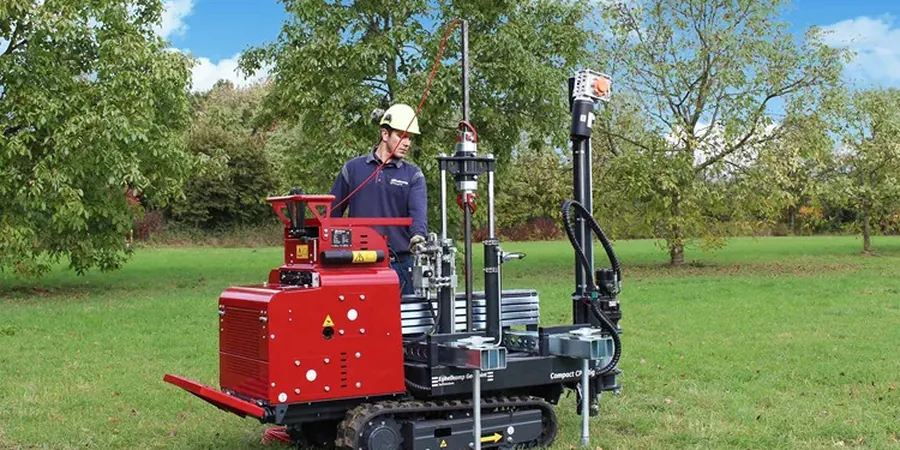
A single CPT push gives you a continuous soil log — no gaps, no missed layers, no assumptions between blow counts.
Approach and scope
Site-specific factors
The coastal fog and seasonal rain in Oakland saturate the upper 5 meters of the soil profile, creating a phreatic surface that varies by 3 meters between summer and winter. This fluctuating water table directly affects the pore pressure readings of the CPT. If we push during a dry spell, the u2 values may underestimate the true hydrostatic pressure during a wet February. We correct for this by installing a standpipe piezometer before the test and logging the water level for 24 hours. The risk is a misclassified soil layer — calling a moist clay a dry silt — which can lead to an under-designed foundation. Our field protocol always includes a pre-test water table measurement.
Service video
Relevant standards
ASTM D5778-20 (Standard Test Method for Electronic Friction Cone and Piezocone Penetration Testing of Soils), Caltrans CPT Field Manual (2018), Robertson & Campanella (1983) Soil Behavior Type Charts
Related technical services
Seismic CPT (SCPT)
Adds a geophone array to measure vs30/" data-interlink="1">shear wave velocity (Vs) every meter. Used for site class determination per ASCE 7-16. Ideal for high-rises near Lake Merritt.
Piezocone Dissipation Test
Holds the cone at a selected depth to measure the dissipation of excess pore pressure. Gives the coefficient of consolidation (cv) for soft clay layers under the Oakland estuary.
Environmental CPT (ECPT)
Fitted with a hydrocarbon sensor and electrical conductivity module. Used for contamination delineation at former industrial sites along the Oakland waterfront.
Typical parameters
FAQ
How deep can the CPT reach in Oakland soils?
In the sandy deposits of central Oakland (around Grand Lake), we typically reach 30 to 35 meters. In the soft estuarine clays near Jack London Square, the cone can go deeper — up to 45 meters — because the resistance is lower. We stop when we hit refusal (above 150 MPa tip resistance) or the rig reaches its push limit.
What is the difference between CPT and SPT for Oakland projects?
The SPT gives a blow count every 0.6 meters, but the CPT gives a continuous reading every 2 cm. In Oakland's interlayered soils (sands over clays over sands), the CPT catches every thin seam. The SPT can miss a 10 cm thick liquefiable silt layer. For seismic design, the CPT is far more reliable because it provides a continuous vs30/" data-interlink="1">shear wave velocity profile when paired with a seismic module.
How much does a CPT sounding cost in Oakland?
A standard CPT push in Oakland, including mobilization within Alameda County, typically ranges between US$160 and US$230 per linear foot. This includes data logging, real-time pore pressure readings, and a preliminary soil behavior type report. The final price depends on depth, number of dissipation tests, and site access conditions.
Do you need a permit to run a CPT rig in Oakland?
Yes. The City of Oakland requires a Street Cut Permit if the rig blocks a lane or sidewalk, plus an Encroachment Permit if we work within the public right-of-way. For private lots, we just need written owner authorization. Our crew handles all permit applications with the city's Public Works Department.