A mid-rise residential project near Lake Merritt in Oakland revealed a critical challenge: the top 20 meters of soft alluvial clay and fill could amplify earthquake shaking significantly compared to a rock site. Without a proper site response analysis in Oakland, the design team risked underestimating spectral accelerations by a factor of 1.5 or more. That gap translates directly into under-designed shear walls and foundations. We performed a site response analysis using SHAKE2000 and the recorded motions from the 1989 Loma Prieta earthquake, which had a magnitude of 6.9 and caused extensive damage in the Marina District of San Francisco. For Oakland, the combination of young Bay Mud and loose sand layers creates a classic basin effect. Before finalizing the structural model, we recommend coupling the analysis with a [MASW survey](/masw-vs30/) to constrain the shear-wave velocity profile down to 30 m depth.
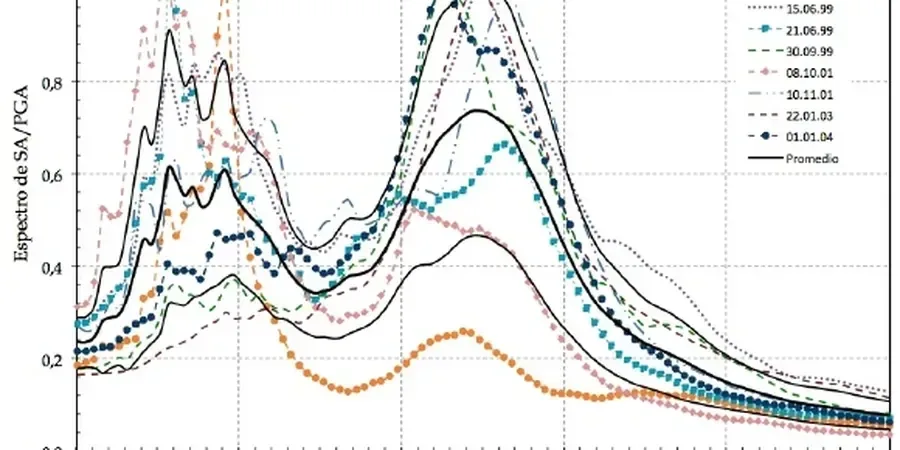
For soft soil profiles in Oakland, the amplification factor between rock outcrop and surface motion can exceed 2.5, directly affecting design spectra.
Approach and scope
Site-specific factors
Oakland sits within the San Francisco Bay Area, a region with a 72% probability of a magnitude 6.7 or greater earthquake by 2045 according to the USGS. The 1989 Loma Prieta earthquake (M6.9) caused soil liquefaction and lateral spreading along the Oakland estuary, damaging the Cypress Street Viaduct and dozens of waterfront structures. A site response analysis in Oakland specifically addresses the risk of ground motion amplification in the soft Holocene alluvium and Bay Mud that underlies much of the flatland. Ignoring this amplification leads to under-designed foundations and increased collapse risk. We follow the NCEER procedures for liquefaction triggering evaluation and the Youd-Idriss 2001 method to assess cyclic resistance. For sites near the Oakland-Alameda estuary, the analysis must also account for the potential of lateral spreading and post-liquefaction settlement.
Relevant standards
ASCE 7-16 Minimum Design Loads and Associated Criteria for Buildings (Section 11.4: Site Class and Design Response Spectrum), NEHRP Recommended Seismic Provisions (FEMA P-1050) for definition of Site Class B, C, D, E, F, ASTM D4428-19 Standard Test Methods for Crosshole Seismic Testing, California Building Code (CBC 2022) based on IBC 2021 with California amendments for seismic design
Related technical services
Shear-Wave Velocity Profiling (MASW / ReMi)
We deploy multi-channel analysis of surface waves (MASW) or refraction microtremor (ReMi) arrays to determine the Vs30 profile. This non-invasive method works well in Oakland's urban environment where drilling is restricted. The resulting velocity model directly feeds into the site response analysis and site class assignment per ASCE 7.
Ground Response Analysis (1-D Equivalent Linear & Nonlinear)
Using the measured shear-wave profile and selected input ground motions, we run 1-D site response analyses with programs such as SHAKE2000 or DEEPSOIL. The output includes acceleration time histories at the surface, response spectra at multiple damping ratios, and amplification factors. We also compute the strain-compatible modulus reduction and damping curves for each soil layer.
Typical parameters
FAQ
What is site response analysis and why is it necessary in Oakland?
Site response analysis is a numerical simulation that predicts how local soil layers modify earthquake ground motions as they travel from bedrock to the surface. It is necessary in Oakland because the Bay Mud and alluvial deposits can amplify shaking by a factor of 2 to 3 compared to a rock site. The analysis provides a site-specific design response spectrum that reflects the actual soil conditions, rather than using generic code spectra.
How does the site response analysis differ from a standard geotechnical investigation?
A standard geotechnical investigation focuses on bearing capacity, settlement, and soil classification. Site response analysis is a specialized dynamic study that requires shear-wave velocity profiling, cyclic soil properties (G/Gmax and damping curves), and multiple input ground motions. It directly produces the design ground motions for the structural engineer, whereas a standard investigation provides only static soil parameters.
What input ground motions do you use for Oakland sites?
We typically use a suite of 3 to 7 recorded ground motions from earthquakes with similar magnitude and distance as the controlling scenario for Oakland. Common records include the 1989 Loma Prieta earthquake (station at the Oakland Outer Harbor Wharf) and the 1994 Northridge earthquake. We also use synthetic motions from the USGS NGA-West2 database scaled to the target uniform hazard spectrum for the site.
How much does a site response analysis cost in Oakland?
The cost ranges from US$1.130 to US$4.360 depending on the number of profiles, the number of input motions, and whether you need a full nonlinear analysis or an equivalent-linear approach. The price includes field shear-wave velocity testing, laboratory cyclic testing if needed, and a detailed report with design spectra. Contact us for a project-specific quote.
What is the difference between Site Class D and Site Class E in Oakland?
Site Class D has a Vs30 between 180 and 360 m/s, typical of stiff soil or dense sand. Site Class E has a Vs30 of less than 180 m/s, which corresponds to soft clays like Bay Mud. Oakland's flatlands near the estuary are often Site Class E, while the Oakland Hills are Site Class B or C. The distinction matters because ASCE 7 applies different amplification factors: Site Class E can amplify spectral accelerations by up to 1.6 times compared to Site Class D for short-period structures.