Oakland sits on a complex mix of alluvial fans, bay mud, and colluvium from the Oakland Hills. In our experience, the most common mistake here is assuming uniform soil conditions across a single lot. We have seen N-values drop from 40 to 4 within ten feet, especially near the former Lake Merritt shoreline. That is why we always recommend an SPT (Standard Penetration Test) program to capture this variability before any design work. The split-spoon sampler gives us a disturbed sample for classification and a blow count that correlates directly with bearing capacity. For projects on the estuary side, we often pair the SPT with a MASW survey (Vs30) to map shear wave velocity profiles for seismic site classification. The combination of direct and indirect methods saves time and reduces uncertainty.
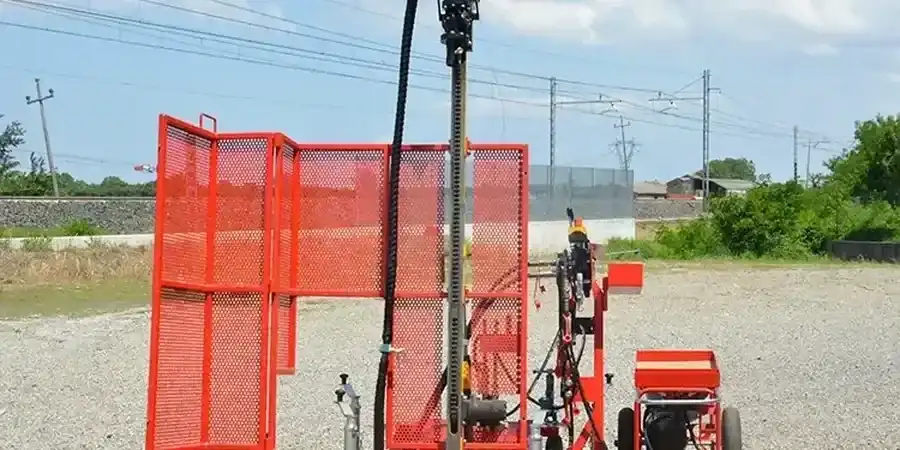
N-values in Oakland can drop from 40 to 4 within ten feet, especially near the former Lake Merritt shoreline. We capture that variability.
Approach and scope
Site-specific factors
ASCE 7-22 and the California Building Code (CBC) mandate site-specific seismic hazard analysis for all new buildings in Oakland. The city lies within Seismic Zone 4, with peak ground accelerations up to 0.6g. Liquefaction hazard is high along the estuary and around Lake Merritt, where shallow groundwater sits within 5 feet of the surface. An SPT program is the primary tool for evaluating liquefaction triggering using the Seed-Idriss simplified procedure (Youd et al., 2001). Without reliable N-values corrected to an energy ratio of 60% (N60), the calculated factor of safety against liquefaction can be misleading. We have seen projects where uncorrected blow counts overestimated liquefaction resistance by nearly 30%. That is a risk no engineer should accept in Oakland.
Service video
Relevant standards
ASTM D1586-18 (Standard Test Method for SPT and Split-Barrel Sampling), ASCE 7-22 (Minimum Design Loads for Buildings, Section 11.4 – Site Class), California Building Code (CBC) Chapter 18 – Soils and Foundations, Youd et al. 2001 (NCEER/NSF Workshop on Liquefaction Resistance – SPT-based method)
Related technical services
SPT Field Borings
Mobilization of CME-75 or truck-mounted drill rigs for SPT at 5-ft intervals in cohesive soils and 2.5-ft intervals in sands. Continuous sampling in Bay Mud. Depth range from 20 ft to 100 ft depending on foundation load. Real-time blow count logging on site.
SPT Sample Classification & Lab Testing
Visual-manual classification per ASTM D2488, moisture content, Atterberg limits, and grain size analysis on recovered split-spoon samples. We store samples in sealed jars for future reference. Results tied to borehole log and N-value profile.
SPT-Based Seismic & Foundation Analysis
Correction of raw N-values to N60 and (N1)60. Calculation of bearing capacity, settlement, and liquefaction triggering. Correlation to relative density and friction angle for foundation design. Deliverables include borehole logs, summary table, and engineering report.
Typical parameters
FAQ
How does the SPT correlate to bearing capacity in Oakland's Bay Mud?
In Bay Mud, where N-values are typically 0 to 4, direct correlation to bearing capacity is unreliable because the soil behaves plastically. We use the SPT primarily for consistency evaluation and to identify lenses of sand or silt. For bearing capacity, we run unconfined compression tests on undisturbed tube samples and apply Skempton's method for cohesive soils. The SPT blow count in these soft clays serves more as a qualitative index than a quantitative design parameter.
What is the typical cost range for an SPT program in Oakland?
For a standard project with 3 to 5 borings to 30 ft depth, including field work, lab testing, and a report, the cost typically ranges between US$470 and US$800 per boring. This includes mobilization within Alameda County, ASTM D1586 compliance, and corrections for hammer energy. Deep borings or sites with limited rig access may increase the cost. We can provide a firm quote after reviewing the site plan and target depth.
How do you correct SPT N-values for hammer energy in the field?
We measure hammer energy efficiency using a Pile Driving Analyzer (PDA) on the drill rig. The automatic trip safety hammer on our CME-75 delivers approximately 60% to 70% of theoretical free-fall energy. We calculate the energy correction factor CE = measured energy / 60%. Then we apply the correction: N60 = N_field × CE. This step is critical because uncorrected blow counts can overestimate soil strength by 15% to 30%, especially in medium sands.
Can SPT be used for liquefaction assessment in Oakland's estuarine soils?
Yes, the SPT is the most widely accepted method for liquefaction triggering evaluation in Oakland. We apply the Youd-Idriss (2001) procedure using corrected (N1)60 values. For the estuarine deposits near Jack London Square, where groundwater is shallow, we typically find that clean sand layers with (N1)60 below 15 are susceptible to liquefaction under the CBC design earthquake (M7.1 on the Hayward Fault). We always pair SPT with cyclic triaxial testing on representative samples for site-specific validation.