The Franciscan Complex bedrock underlying much of Oakland presents variable conditions for landfill siting, with sheared shale and serpentinite zones that can create preferential flow paths for leachate. Our team has logged dozens of borings along the East Bay foothills where the contact between Quaternary alluvium and the bedrock is often abrupt. For a recent cell expansion near the Oakland Estuary, we deployed continuous SPT sampling per ASTM D1586 at 1.5 m intervals to map the clay till thickness and identify any permeable sand lenses. The results directly informed the liner system design and the geomallas reinforcement layout for the base layer. Combining these borehole logs with in-situ permeability tests allowed us to calibrate the hydraulic conductivity assumptions used in the leachate generation model for the site.
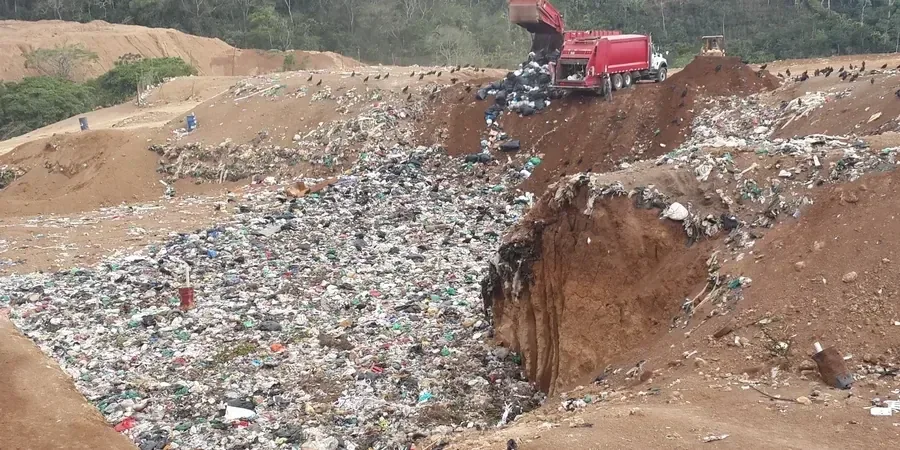
Variable Bay Mud plasticity across a single Oakland parcel demands site-specific compaction curves — generic values will fail the permeability criterion.
Approach and scope
- Atterberg limits (ASTM D4318) on every soil horizon encountered to classify the clay according to the Unified Soil Classification System (ASTM D2487).
- Modified Proctor compaction curves (ASTM D1557) at four energy levels to define the optimum moisture window for the clay liner.
- Falling-head permeability on undisturbed specimens to verify that the compacted liner achieves the target coefficient of permeability (k ≤ 1×10⁻⁷ cm/s).
Site-specific factors
Oakland sits within the San Andreas fault system with a 72% probability of a M≥6.7 earthquake by 2043 according to UCERF3. In a landfill context, seismic loading can trigger liquefaction of the foundation soils below the waste mass, leading to lateral spreading and tearing of the liner system. Our landfill geotechnics protocol for Oakland sites always includes cyclic triaxial testing (ASTM D5311) on the foundation clay to evaluate post-cyclic strength loss. For the waste mass itself we model the dynamic response using site-specific vs30/" data-interlink="1">shear wave velocity profiles from MASW surveys to avoid relying on generic acceleration values from the USGS hazard map alone.
Relevant standards
ASTM D1586-18 (SPT), ASTM D4318-17 (Atterberg Limits), ASTM D1557-12e1 (Modified Proctor), ASTM D5084-16a (Permeability), ASCE 7-22 (Seismic Loads)
Related technical services
Liner System Design Verification
Compaction control testing and permeability verification for composite clay liners, including field density tests (ASTM D6938) and laboratory hydraulic conductivity on undisturbed ring samples.
Seismic Stability & Liquefaction Screening
Cyclic triaxial testing on foundation soils, vs30/" data-interlink="1">shear wave velocity profiling (MASW), and post-seismic settlement analysis using NCEER-based simplified procedures.
Leachate Management Geotechnics
Hydraulic conductivity testing of drainage layers, long-term compatibility testing between liner clay and leachate, and slope stability analysis of the waste mass under saturated conditions.
Typical parameters
FAQ
What is the typical cost range for a landfill geotechnics investigation in Oakland?
For a mid-size cell expansion (5–10 acres) including SPT borings, lab testing, and a design report, clients can expect a range between US$2.370 and US$7.150 depending on the number of borings and the complexity of the liner design.
How deep should borings go for a new landfill cell in Oakland?
We recommend extending borings at least 3 m below the planned liner base or until encountering bedrock, whichever comes first. In the Oakland foothills, that often means 12–18 m total depth to cross the alluvial cover and reach competent Franciscan bedrock.
Do Oakland landfills require special seismic design beyond IBC minimum?
Yes. Because Oakland is in Seismic Design Category D/E, the landfill geotechnics must include site-specific response spectra (per ASCE 7-22) and liquefaction triggering analysis for the foundation soils. Generic IBC values underestimate the cyclic demands on the liner system.
What laboratory tests are most critical for the clay liner permeability specification?
Modified Proctor compaction (ASTM D1557) to define the moisture-density relationship, followed by falling-head permeability tests (ASTM D5084) on specimens compacted at 95% of MDD. Atterberg limits are also essential to confirm the clay meets the minimum PI of 20 required by most regulatory agencies.