Oakland sits on a complex mix of Franciscan Complex bedrock, alluvial fans, and artificial fill along the estuary. With over 430,000 residents and a port moving 2.4 million TEUs annually, the city's pavements endure heavy truck loads, seismic settlement, and decades of deferred maintenance. An existing pavement evaluation in Oakland is the first step before any overlay, reconstruction, or widening project. We core asphalt and concrete layers, measure layer thickness, and assess the subgrade modulus using Falling Weight Deflectometer (FWD) testing. For deeper profiles, we combine this with MASW-Vs30 to map stiffness contrasts beneath the pavement structure, and georadar GPR to detect voids or delamination without trenching.
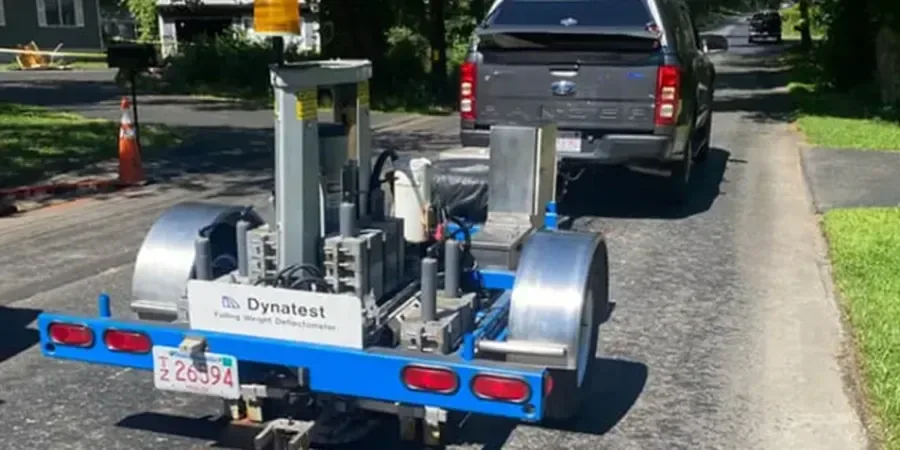
A pavement evaluation in Oakland must account for seismic settlement and variable fill — standard coring alone misses the deeper story.
Approach and scope
Site-specific factors
The pavement coring rig we deploy in Oakland is a trailer-mounted core drill with a diamond-tipped bit cooled by a water tank. We position it over the marked spot, stabilize the frame with hydraulic jacks, and cut a clean cylinder through asphalt or concrete. The risk? Hitting an undocumented underground utility — gas, fiber, or decommissioned water lines from the 1920s. We coordinate with USA DigAlert 48 hours in advance, review as-built records from the City of Oakland Public Works, and use a private utility locator before every cut. A dry core avoids slurry damage to adjacent lanes, but we still contain runoff with vacuum trucks on busy streets like International Boulevard.
Relevant standards
ASTM D1586-18 (SPT in subgrade boreholes), ASTM D4694-09 (Falling Weight Deflectometer), AASHTO T-307 (Resilient Modulus of Subgrade), ASTM D6433-20 (Pavement Condition Index)
Related technical services
Pavement Condition Survey & Distress Mapping
Field inspection per ASTM D6433 to catalog cracking, rutting, raveling, potholes, and faulting. We GPS-locate each distress, assign severity levels, and calculate the Pavement Condition Index (PCI) for each section.
Structural Capacity Testing (FWD & Coring)
Falling Weight Deflectometer testing at 500-ft intervals to back-calculate layer moduli. Complemented with full-depth cores for visual mix analysis, thickness verification, and laboratory resilient modulus. Results feed directly into overlay design.
Subgrade Investigation & Rehabilitation Design
Boring to 5-10 ft below pavement to classify subgrade soils, measure in-situ moisture content, and run CBR or R-value tests. We then propose rehabilitation strategies: mill-and-fill, full-depth reclamation, or geogrid reinforcement.
Typical parameters
FAQ
When do I need an existing pavement evaluation in Oakland?
Any time you plan an overlay, reconstruction, or change in use. Oakland requires a pavement evaluation for commercial permits involving more than 1,000 sq ft of new asphalt. It also applies when buying a property with cracked pavement to assess future liability.
What is the difference between FWD testing and coring?
FWD measures the deflection bowl under a falling weight to calculate the structural capacity of each layer without damaging the pavement. Coring extracts a physical sample to verify thickness, air voids, and binder content. Both are complementary; FWD gives you the strength profile, coring gives you the material reality.
How does Oakland's seismic setting affect pavement evaluation?
Oakland sits near the Hayward Fault, which can produce M7.0 events. Liquefaction in fill zones along the estuary causes differential settlement that cracks rigid pavements. Our evaluation includes a seismic site class assessment per ASCE 7 and checks for fault rupture or lateral spreading risk before recommending rigid sections.
What is the typical cost for a pavement evaluation in Oakland?
The range for a standard evaluation covering 5-10 test locations on a 50,000 sq ft lot is between US$1,280 and US$3,960. This includes coring, FWD testing, lab work, and a report with overlay recommendations. Larger sites or those requiring seismic analysis cost more.
How long does the evaluation take from start to report?
Fieldwork takes one to two days for a typical parking lot or street segment. Lab testing adds three to five business days. The final report with PCI scores, structural numbers, and overlay designs is delivered within seven to ten business days after the site visit.